Key facts
Name
Guadalupe Santiago “G.S.” Garcia
Known for
Saddles, bits, spurs and fine Western gear
World’s Fair recognition
Gold-medal honors in 1904 and 1905
Historic shop building
1907 G.S. Garcia Saddle & Harness Shop, now the Cowboy Arts & Gear Museum at 542 Commercial St., Elko
Garcia Bit & Spur legacy
J.M. Capriola acquired Les Garcia’s Garcia Bit & Spur business in 1978
Modern Garcia serial numbering
In use since 1985
Who was G.S. Garcia?
Guadalupe Santiago “G.S.” Garcia was a saddlemaker, businessman and Western gear maker whose name became closely associated with Elko, Nevada, and the California-vaquero tradition of finely made bits, spurs and saddlery.
Garcia learned the saddlery trade in California and operated a shop in Santa Margarita before moving to Elko. He opened his Elko business in 1894, where demand from working cowboys helped the shop grow into an important Western gear operation. By the late 1890s, Garcia was offering bits, spurs and other equipment to a wider market through catalogs.
Garcia’s shop employed highly skilled craftsmen rather than functioning only as a one-man workshop. Pieces carrying the G.S. Garcia shop mark therefore represent the Garcia business and its craftsmen; the hallmark does not necessarily mean Guadalupe Garcia personally fabricated every component.
Garcia achieved international recognition through elaborate exhibition saddlery that earned gold-medal honors at the 1904 Louisiana Purchase Exposition in St. Louis and the 1905 Lewis and Clark Centennial Exposition in Portland. His award-winning “Beauty Saddle” is preserved by the Nevada State Museum.
Garcia died in 1933, but the family business and the Garcia name continued through later shops and generations. That long history is one reason collectors must identify the exact mark and era before assuming what a “Garcia” piece is.
Not every “Garcia” is the same Garcia
One of the biggest mistakes in collecting Garcia bits and spurs is treating the word “Garcia” as a single maker mark. We have documented several distinct Garcia shops and periods, and their age, rarity and collector value can differ substantially.
G.S. Garcia / Elko, Nev.
G.S. Garcia’s Elko-era business and its craftsmen
G.S. Garcia era: Late 1890s–1933
This is the early Garcia name most collectors are usually seeking. Genuine pieces can carry variations of the G.S. Garcia / Elko mark, and some early genuine pieces may be unmarked.
Garcia Saddlery Co. / Salinas, Calif.
The Garcia family business after G.S., associated with his sons
Mid-1930s through the mid-1960s
Legitimate Garcia-family work, but a different period and shop from the early G.S. Garcia Elko pieces.
Les Garcia / Reno — or Garcia / Reno — or Garcia
Leslie “Les” Garcia, G.S. Garcia’s son
Late 1950s through 1978
Les Garcia was part of the family business and later operated his own Garcia Bit and Spur Manufacturing Company in Reno. His work should not be automatically represented as an early G.S. Garcia Elko piece.
E Garcia
Eduardo Garcia of San Ysidro, California
1980s through the 2000s
Eduardo Garcia was not related to G.S. Garcia’s family. Our records note that his marked pieces are often confused with the older Garcia name. They have their own collector following but are not antique G.S. Garcia pieces.
Garcia / Elko, NV + serial number
Modern Garcia production associated with J.M. Capriola in Elko
Modern; serial-number system in use since 1985
Modern genuine Garcia gear should not be confused with an antique G.S. Garcia piece simply because both carry the Garcia and Elko names.
Published timelines differ on the exact transition and production years between Garcia shops, particularly around the Salinas period, so this guide uses broad periods rather than pretending every change happened on one universally agreed date.
What does the backwards “N” in “NEV.” mean?
Collectors often focus on an early G.S. Garcia mark in which the “N” in “NEV.” appears backwards. It is a useful early-period clue, but it should not be treated as a precise date stamp.
We have historically described backwards-N examples as early-1900s pieces and have used approximate dates around 1900–1910. Other respected Garcia references commonly associate the backwards-N mark with roughly 1910–1920, although a Western Horseman caption dates it to before 1910. Because published dating is not completely consistent, the safest conclusion is that the mark belongs to the early G.S. Garcia period — not that the backwards N alone proves one exact production year.
A maker mark should be evaluated together with construction, engraving, materials, pattern, wear, provenance and comparison with documented examples.
An early G.S. Garcia hallmark whose exact dating varies among published references.
Catalog patterns: A better way to compare known Garcia pieces
Historic Garcia catalogs are valuable collector references because documented bits and spurs can sometimes be matched to named or numbered patterns.
We have handled G.S. Garcia spurs that correspond directly with catalog patterns, including Dandy pattern #75 and pattern #10. A catalog match can strengthen identification and help place a piece within the Garcia design tradition, but a pattern number is not a unique serial number and does not by itself authenticate an object.
The Dandy Pattern
An auction preview describes the Dandy as a highly sought-after G.S. Garcia pattern, documented as catalog pattern #75/75A in the 1898 Garcia Saddlery catalog. We have documented both single-mounted and double-mounted examples of Dandy pattern #75.
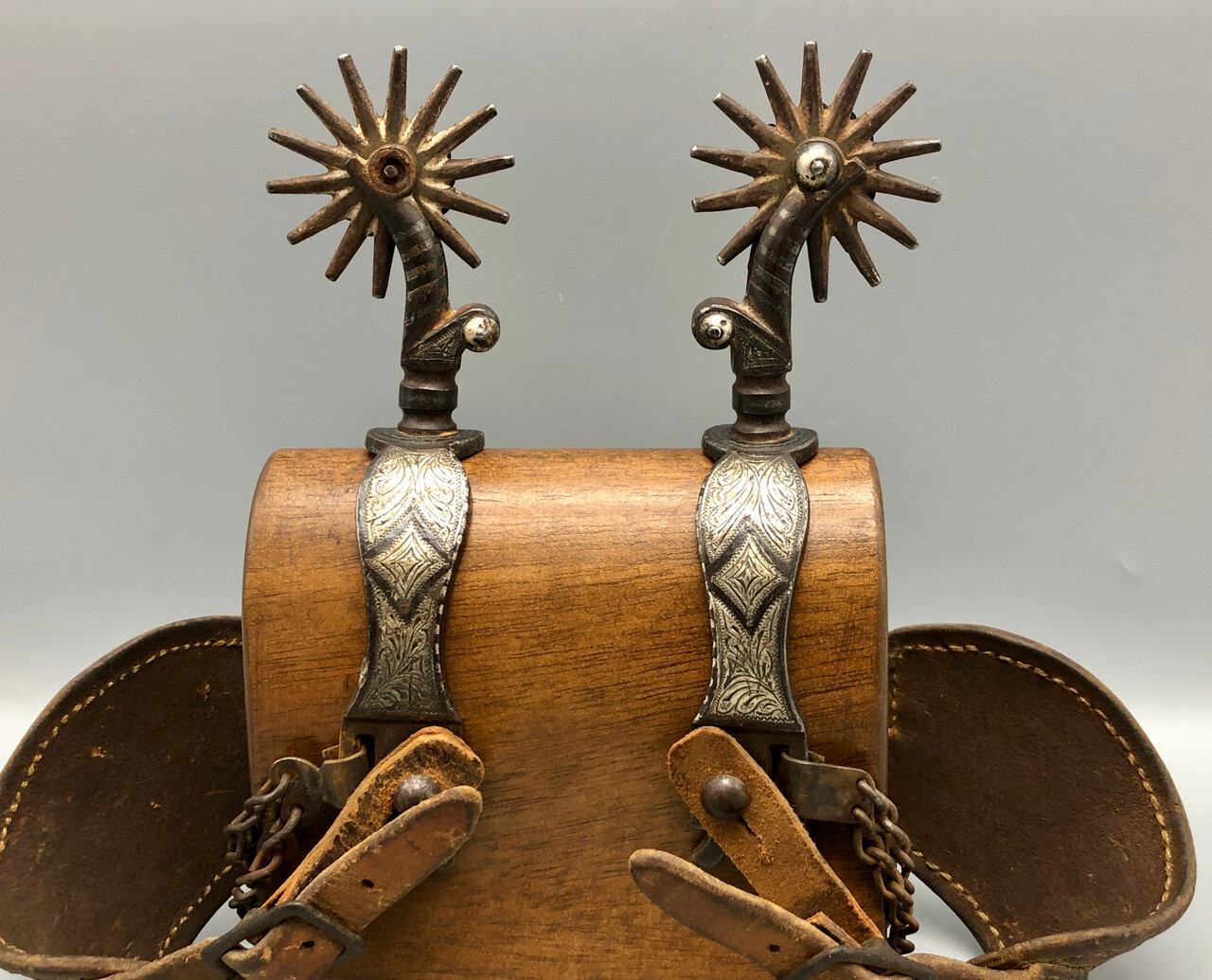
Dandy pattern #75 — double mounted — WTP.SP107
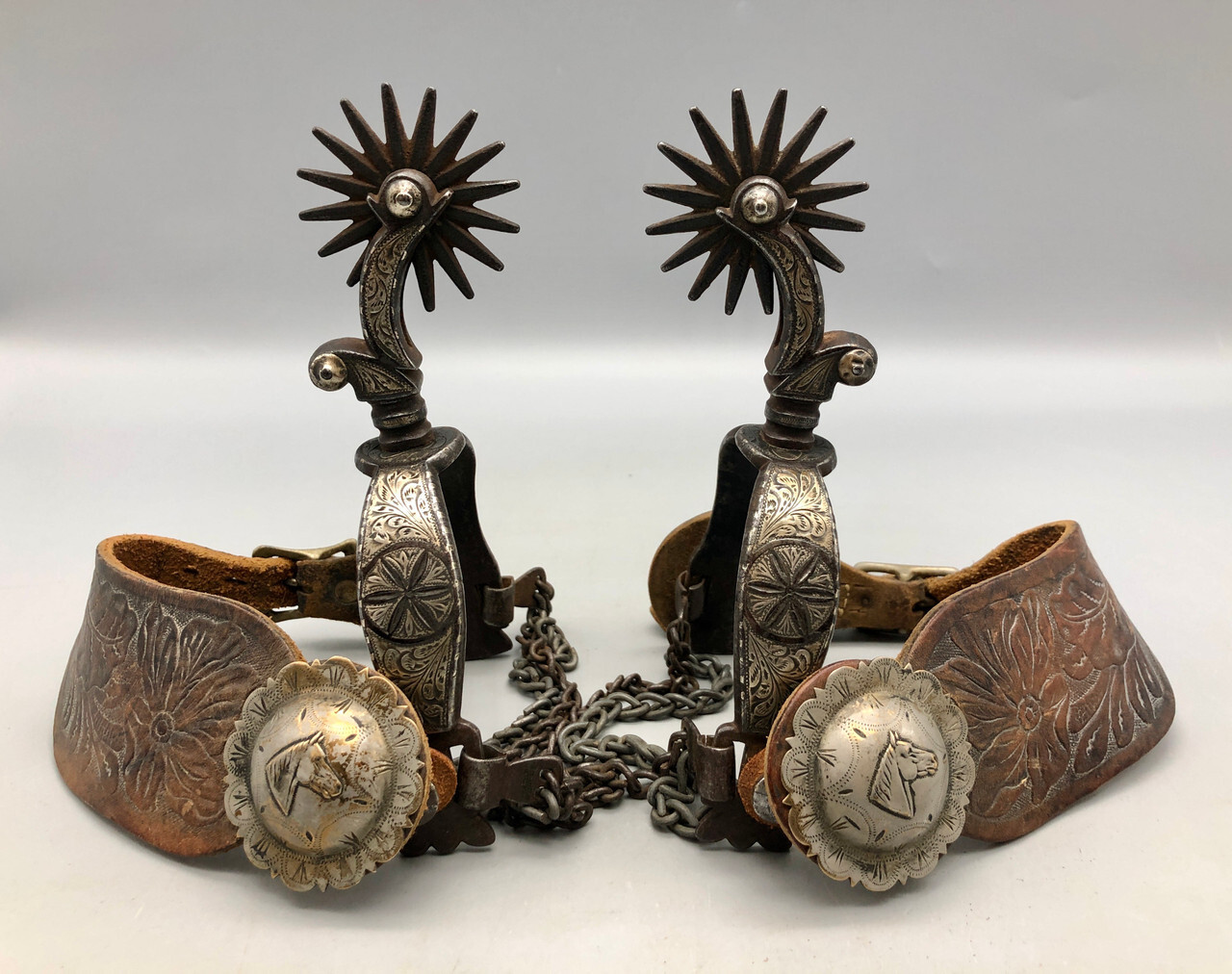
Dandy pattern #75 — single mounted — WTP.SP108
Pattern #10
We have also documented an original G.S. Garcia pair identified as pattern #10 on page 61 of an old G.S. Garcia illustrated catalog.
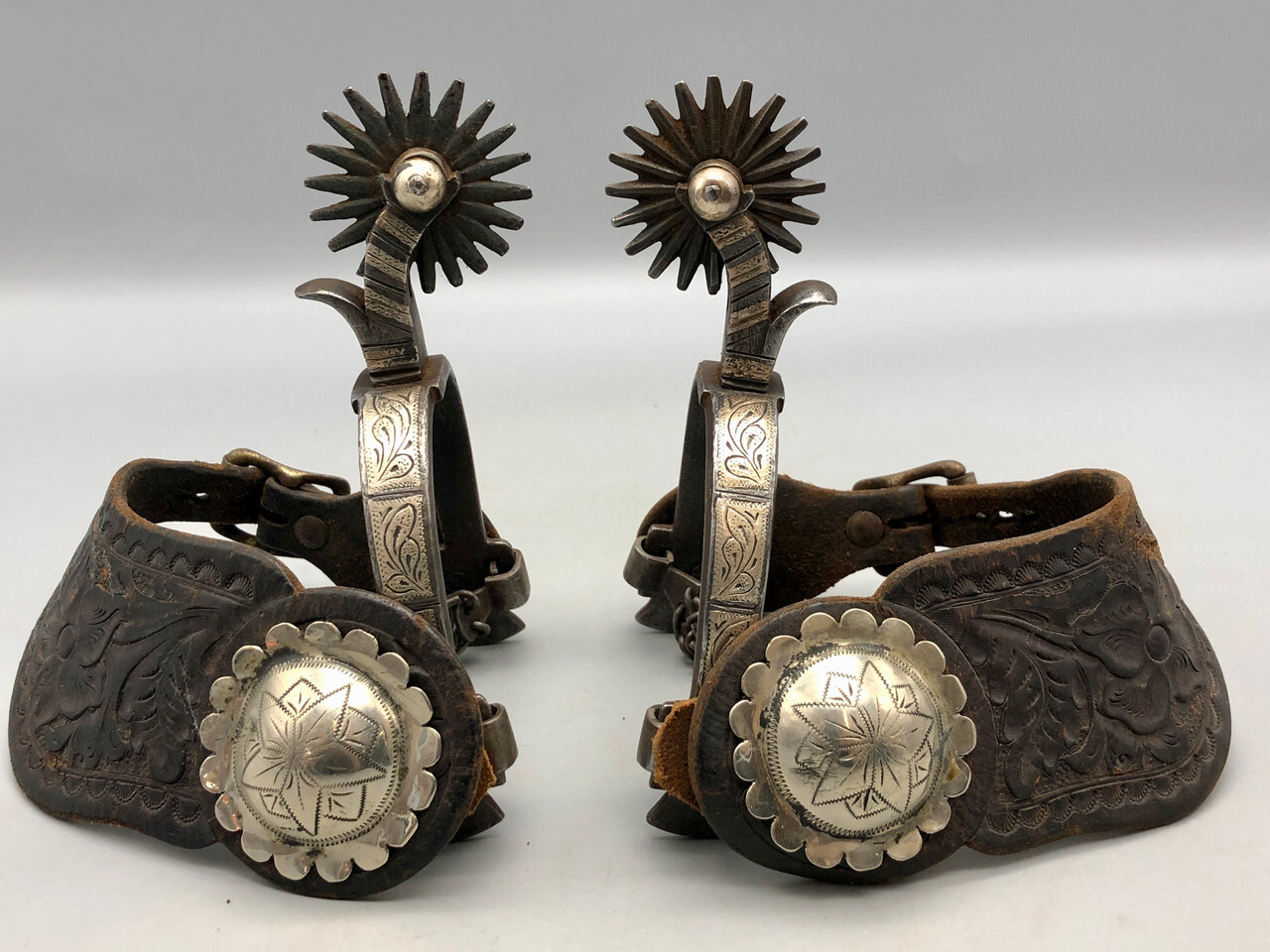
Pattern #10 — WTP.SP109
What should collectors look for?
Maker mark
Start with the exact wording, location and style of the mark. “G.S. Garcia / Elko, Nev.,” “Garcia Saddlery Co. / Salinas,” “Les Garcia / Reno,” “E Garcia,” and modern “Garcia / Elko” marks belong to different histories.
Pattern and construction
Compare the shape, decoration, cheek or shank design, mounting style and other construction details with documented Garcia examples and period catalog patterns.
Materials and engraving
Published Garcia references note that older pieces commonly used coin silver, while later work may use sterling or fine silver. Early engraving can also appear coarser than modern work because of the materials and tools used.
Wear and provenance
Natural wear should make sense across the entire object. Ownership history, old photographs, family history, prior auction records and other documentation can strengthen a piece’s story.
The mark alone is not authentication
A Garcia mark can be copied or added to a later object. Our records and long-standing Garcia references both warn about fraudulent marks, artificial aging and newer gear being represented as older G.S. Garcia work.
This guide is intended as a collector reference and is not a substitute for physical examination or professional authentication.
Why Garcia authentication matters
Because the Garcia name is highly collectible, our records and long-standing Garcia references both warn about imitation and altered gear. We have documented fraudulent hallmarks being added to pieces, newer spurs being artificially aged, and sellers relying on the Garcia name to imply a history the object may not have.
The opposite problem also exists: not every later Garcia piece is “fake.” Garcia Saddlery, Les Garcia, Eduardo Garcia and modern Garcia production each have their own legitimate histories. The collector’s job is to identify the correct Garcia and era rather than treating every marked piece as either an early G.S. Garcia treasure or a counterfeit.
Previously handled by us
These documented Garcia examples remain useful collector references. The prices below are our historical listing prices, not current asking prices or confirmed auction hammer prices.
Previously handled
G.S. Garcia Dandy Pattern #75 — Double Mounted Spurs
Circa 1910–1930
Our historical listing price: $7,500
SKU WTP.SP107
- Hallmarked G.S. Garcia / Elko Nev.
- Dandy pattern #75
- Pattern referenced on pages 58–59 of the old illustrated catalog
- Double mounted
- Silver inlay
- Original handmade 14-point rowels
- Heel chains and tooled straps
View Previous Listing
Previously handled
G.S. Garcia Dandy Pattern #75 — Single Mounted Spurs
Circa 1910–1930
Our historical listing price: $5,500
SKU WTP.SP108
- Hallmarked G.S. Garcia / Elko Nev.
- Dandy pattern #75
- Pattern referenced on pages 58–59 of the old illustrated catalog
- Single mounted
- Silver inlay
- Original handmade 16-point rowels
- Tooled straps with silver horse-head conchos
View Previous Listing
Previously handled
G.S. Garcia Pattern #10 Spurs
Circa 1910–1930
Our historical listing price: $4,000
SKU WTP.SP109
- Hallmarked G.S. Garcia / Elko Nev.
- Pattern #10
- Pattern referenced on page 61 of the old G.S. Garcia illustrated catalog
- Single mounted
- Original handmade 18-point rowels
- Heel chains and tooled straps
View Previous Listing
Previously handled
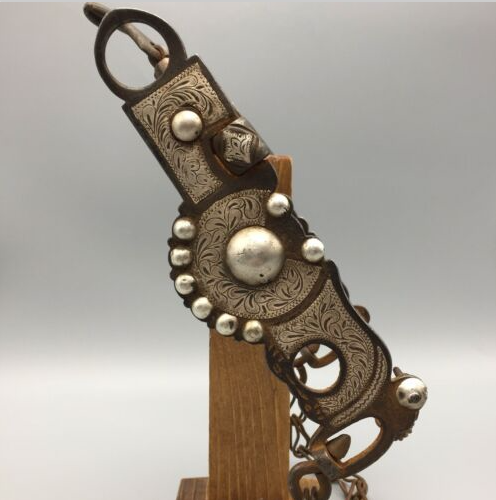
Early G.S. Garcia Spade Bit With Backwards-N Hallmark
Early 1900s
Our historical listing price: $3,500
SKU WTP.BIT022
- Hallmarked G.S. Garcia / Elko Nev.
- Backwards N in NEV
- Silver inlay and overlay
- Hand-stamped details
- 5 3/8-inch mouthpiece
- We described this example as an early-1900s piece
View Previous Listing
Previously handled
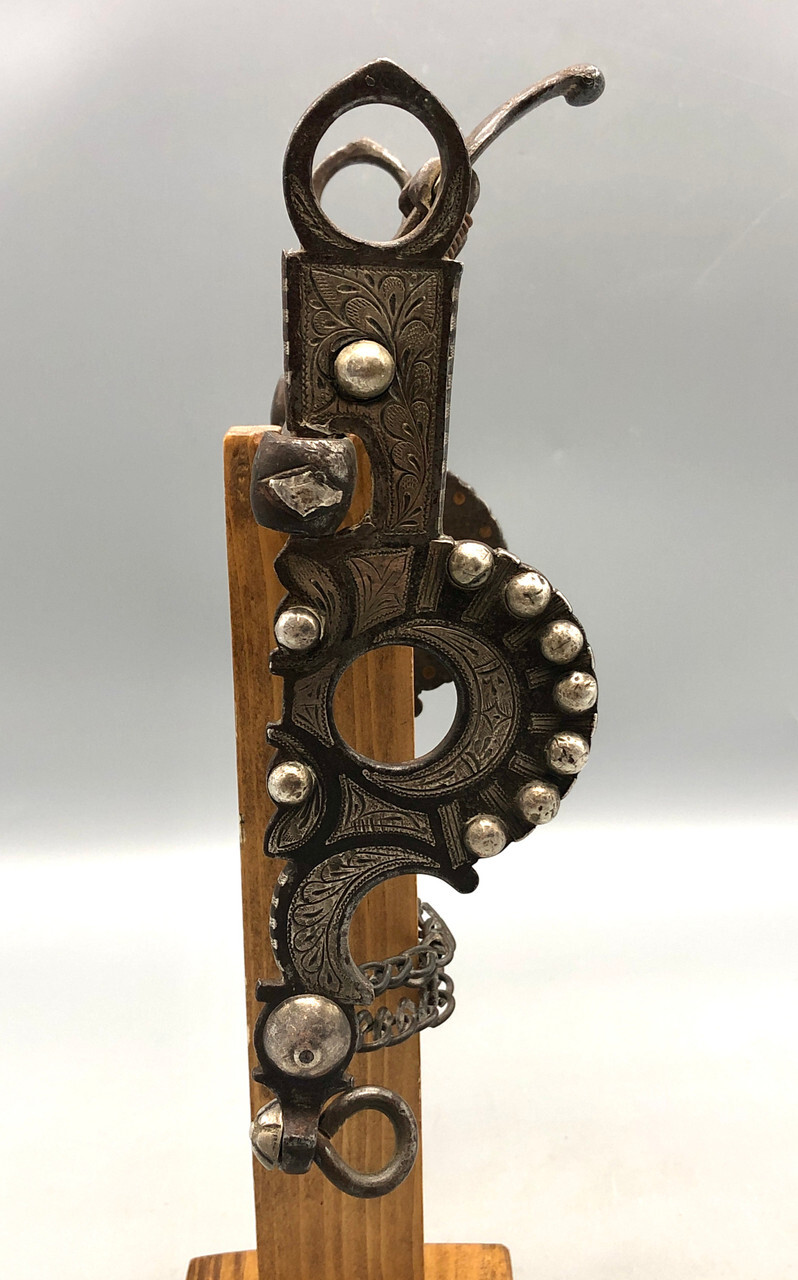
G.S. Garcia Silver-Inlay Spade Bit With Backwards-N Hallmark
Circa 1900–1910, as described in our records
Our historical listing price: $3,750
SKU WTP.BIT117
- Hallmarked G.S. Garcia / Elko Nev.
- Backwards/Dutch N in NEV
- High-port spade
- Copper-wrapped bars
- Silver inlay and engraved conchos
- 5-inch mouth
View Previous Listing
Previously handled
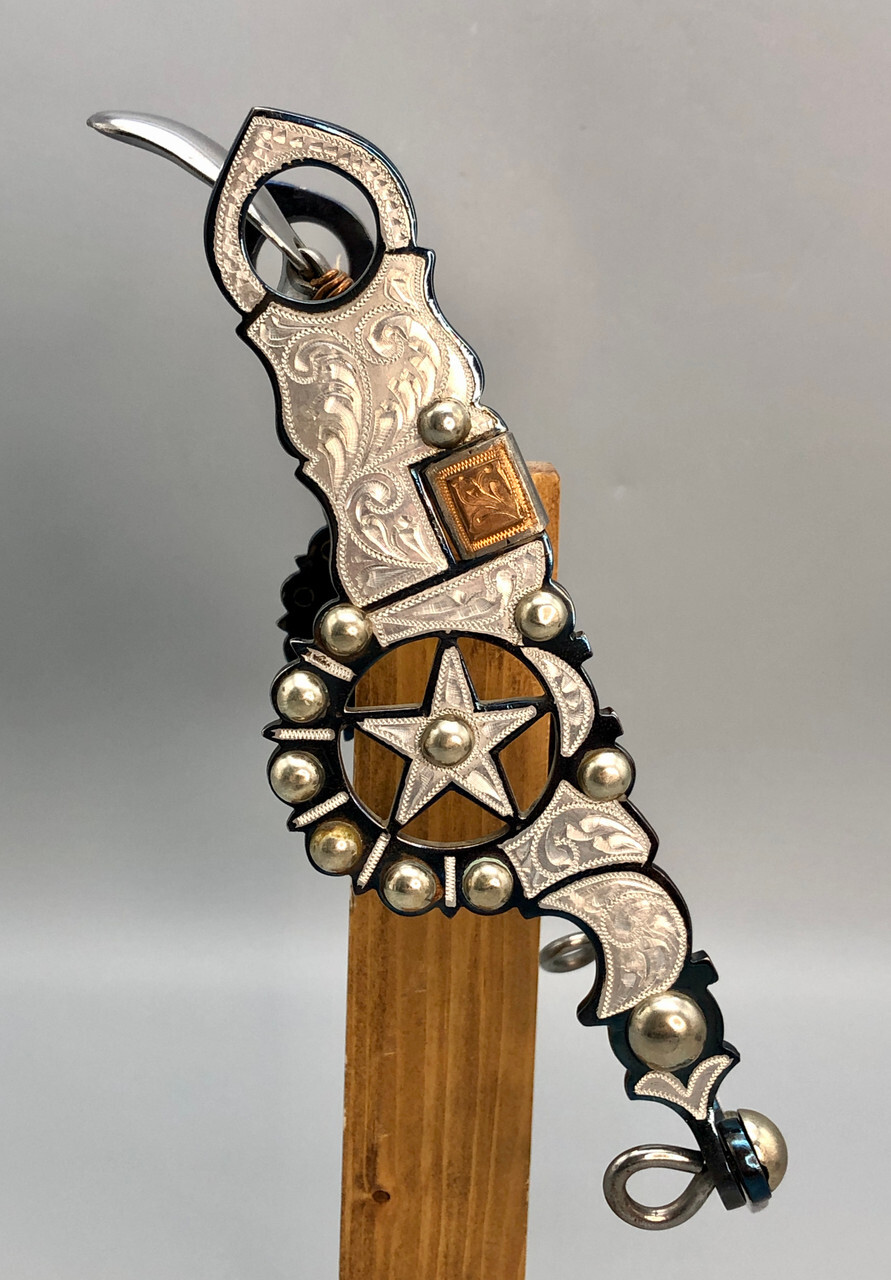
Modern Garcia / Elko Spade Bit
Modern
Our historical listing price: $600
SKU WTP.BIT077
- Hallmarked Garcia / Elko NV
- We identify it as made by Capriola’s
- Purchased new and never used
- Useful comparison example showing why “Garcia / Elko” alone does not mean an antique G.S. Garcia piece
View Previous Listing
Previously handled Les Garcia example
We have also presented a Les Garcia bit with engraved decoration, a fine calfskin braided headstall and braided rawhide reins. It was historically offered by us at $750. This is useful collector context because Les Garcia was part of the Garcia family legacy, but his Reno-era work belongs to a later period than early G.S. Garcia / Elko pieces.
Source: Western Art Collector — Western Trading Post show page, 2023. westernartcollector.com
Find Garcia pieces with us
We periodically handle Garcia bits and spurs through both our shop and auction platform. Because inventory changes, use our live listings for current availability rather than relying on a permanent article to state what is in stock today.
Shop Spurs Shop Bits View Upcoming Auctions
Have a Garcia bit or pair of spurs?
If you own a Garcia bit, pair of spurs or related Western gear and are considering selling or consigning it, we can review the piece and its history.
Before contacting us, photograph:
- the full object
- both sides
- close-ups of all maker marks
- any pattern numbers or serial numbers
- straps, chains, mouthpiece or other components
- any documentation or provenance that came with the piece
Sell or Consign With Us
The Garcia legacy in Elko today
The Garcia name did not disappear when the early Elko shop closed. J.M. Capriola acquired the Garcia Bit and Spur business from Les Garcia in 1978, bringing the Garcia line back to Elko. Modern Garcia production continues the design tradition, and a serial-number system has been used on modern Garcia pieces since 1985.
The surviving 1907 G.S. Garcia shop building, now addressed as 542 Commercial Street, was restored and became the Cowboy Arts & Gear Museum in 2018. The building was added to the Nevada State Register of Historic Places in 2024.
This continuity is precisely why collectors need to distinguish “historic G.S. Garcia” from “modern genuine Garcia.” Both can be legitimate; they simply represent different periods.
Craftsmen behind the Garcia name
G.S. Garcia built a shop around skilled craftsmen and apprentices. Historical accounts connect notable makers including Alsalio Herrera, Juan Estrada and Mike Morales with Garcia’s operation. That matters because a G.S. Garcia hallmark identifies the shop and legacy, not necessarily one individual pair of hands.
FAQ
Are all spurs marked Garcia made by G.S. Garcia?
No. Collectors may encounter early G.S. Garcia / Elko pieces, Garcia Saddlery / Salinas pieces, Les Garcia / Reno pieces, Eduardo “E Garcia” pieces and modern Garcia / Elko production. The exact mark and era matter.
What does a backwards N in “NEV.” mean on a G.S. Garcia piece?
It is associated with the early G.S. Garcia period, but published references do not completely agree on the exact date range. Treat it as an early-period clue rather than a precise date stamp.
Did G.S. Garcia personally make every piece marked G.S. Garcia?
No. Garcia operated a shop that employed accomplished bit, spur, saddle and silver craftsmen. The G.S. Garcia mark ties a piece to the shop and business tradition; it does not prove that Guadalupe Garcia personally made every component.
What is a Garcia Dandy spur?
An auction preview describes the Dandy as a highly sought-after G.S. Garcia pattern, documented as catalog pattern #75/75A. We have handled examples identified as Dandy pattern #75.
Is a Garcia pattern number a serial number?
No. A catalog pattern identifies a design or model reference. It is not a unique serial number for one individual object.
What does “Les Garcia / Reno” mean?
It refers to work associated with Leslie “Les” Garcia, G.S. Garcia’s son, during his later Reno business. Les Garcia pieces are legitimate Garcia-family work but should not be represented as early G.S. Garcia / Elko pieces.
Is E Garcia the same family as G.S. Garcia?
No. We identify Eduardo Garcia of San Ysidro, California, as unrelated to the G.S. Garcia family. His “E Garcia” pieces have their own collector market but are from a much later period.
Are modern Garcia / Elko pieces fake?
No. Modern Garcia production can be genuine. The issue is correct identification: a modern Garcia / Elko piece is not the same thing as an antique G.S. Garcia / Elko piece.
When did modern Garcia serial numbers begin?
Published Garcia references say the modern serial-number system has been in use since 1985.
Can a Garcia maker mark be faked?
Yes. Both our records and established Garcia references warn that marks can be copied or added and that pieces can be artificially aged. Authentication should consider the entire object rather than the stamp alone.
Where was G.S. Garcia’s Elko shop?
The surviving 1907 G.S. Garcia Saddle & Harness Shop now houses the Cowboy Arts & Gear Museum at 542 Commercial Street in Elko. Nevada historic-preservation records identify the building as 547 Silver Street during Garcia’s era.
Where can I sell or consign Garcia bits and spurs?
We handle collectible Western gear through our shop and auction platform. Use the Sell or Consign link on this page to contact us.
Sources & further reading
Western Trading Post
- Jim Olson — “Garcia Spurs,” Western Trading Post, February 21, 2019. westerntradingpost.com/blog/garcia-spurs/
- G.S. Garcia backwards-N horse bit — WTP.BIT022
- G.S. Garcia backwards-N silver-inlay spade bit — WTP.BIT117
- G.S. Garcia Dandy pattern #75 double-mounted spurs — WTP.SP107
- G.S. Garcia Dandy pattern #75 single-mounted spurs — WTP.SP108
- G.S. Garcia pattern #10 spurs — WTP.SP109
- Modern Garcia / Elko spade bit — WTP.BIT077
- “Collector’s Corner: The Importance of Provenance,” Western Trading Post. westerntradingpost.com/blog/collectors-corner-the-importance-of-provenance/
Independent / historical sources
- Nevada Department of Conservation and Natural Resources / State Historic Preservation Office — “Historic Saddle Shop Listed in State Register,” May 15, 2024. dcnr.nv.gov
- Becky Prunty, “Garcia Bits and Spurs,” Western Horseman, originally written January 2001 / republished 2016. westernhorseman.com
- Western Horseman — page 2. westernhorseman.com/.../2/
- Western Horseman — page 3. westernhorseman.com/.../3/
- J.M. Capriola — “Garcia Bits and Spurs.” capriolas.com/garcia-bits-spurs-scrapbook/
- J.M. Capriola — “Twists on Traditional Bits.” capriolas.com/twists-on-traditional-bits/
- Explore Elko — Cowboy Arts & Gear Museum. exploreelko.com
- iCollector Auction News — New Frontier Old West Auctions, lot 193, G.S. Garcia “Dandy” spurs, catalog pattern #75/75A (June 24, 2015)
- High Noon — G.S. Garcia biography