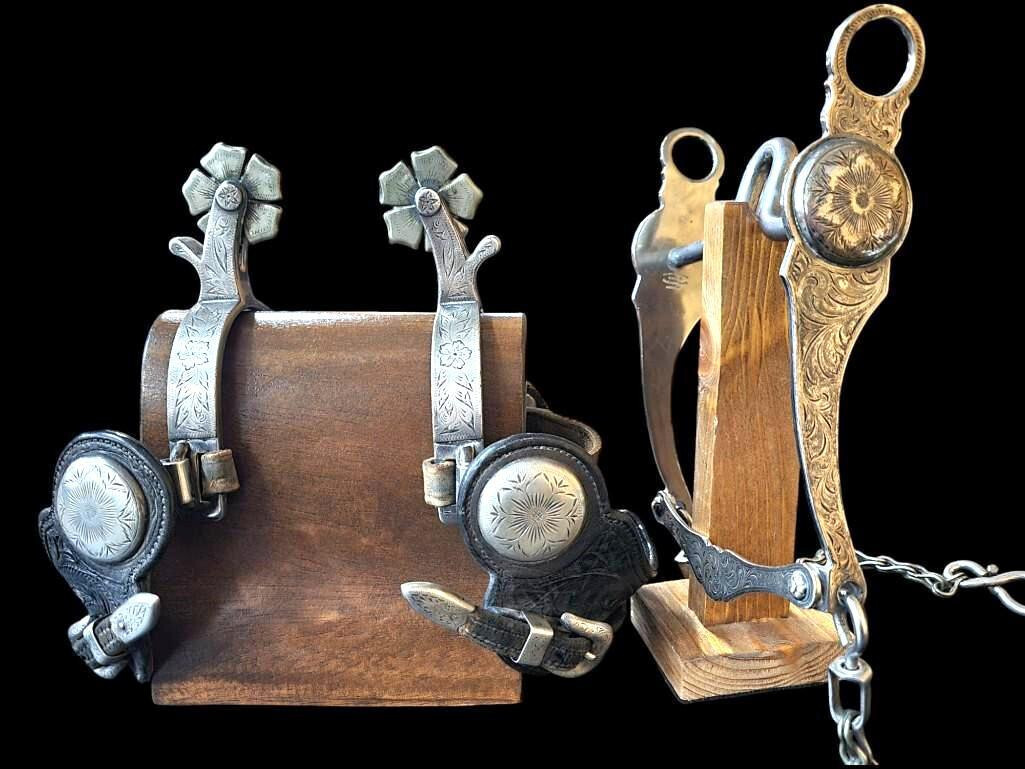
Key facts
Crockett Bit & Spur Co. founded
1920
Original company location
Kansas City, Missouri
Company sold to James Renalde
1951
Kelly acquisition
1965 according to the Autry
Production wound down
1984–1985
Known for
Bits, spurs and extensive catalog patterns
Who was Oscar Crockett?
Oscar Crockett was born in Pecos, Texas, in 1887 and became one of the best-known American bit and spur makers of the early 20th century.
Before establishing the Crockett Bit & Spur Company, Crockett worked within the Western gear trade and operated a shop in Pawhuska, Oklahoma. In January 1920, Oscar Crockett and his uncle W. Brice Crockett purchased the bit-and-spur department of Shipley Saddlery and Mercantile in Kansas City and established the Crockett Bit & Spur Company.
The operation grew quickly. By 1927, the company was producing approximately 5,000 pairs of spurs, and Oscar became sole owner. The business later moved near Lenexa, Kansas, in 1932 and to Boulder, Colorado, in 1943.
Crockett’s success came not from one design but from a broad catalog of practical and decorative Western bits and spurs. By around 1940, published maker histories credit the company with 177 spur styles and 105 bit styles.
Oscar Crockett died in 1949. His widow Hazel continued the business until it was sold to James Renalde in 1951. The Crockett name continued in production after Oscar’s death, which is why collectors should not assume that every item stamped CROCKETT was personally made by Oscar.
Does a CROCKETT mark mean Oscar Crockett made it?
Not necessarily.
The Crockett name covers both Oscar Crockett’s early work and decades of company production. Mark wording and placement can provide useful clues, but the mark must be considered together with construction, pattern, materials, catalog references and provenance.
Early inside-marked pieces are particularly important to collectors, while later Crockett company pieces can carry marks in different locations. The company also continued after Oscar’s death and later passed into Renalde ownership.
For that reason, a Crockett stamp establishes an important maker or company connection, but it should not automatically be translated into “handmade personally by Oscar Crockett.”
Crockett maker marks: What collectors should know
O. CROCKETT — inside heel band
Very early Crockett mark
We have documented O. CROCKETT stamped inside the heel band on very early Crockett spurs. We date one documented star-and-moon pair to approximately 1910–1916.
Other collector references date some early inside-marked Crockett pieces somewhat later. The safest conclusion is that the O. CROCKETT inside mark is an important early-period indicator rather than an exact year stamp.
Early-period mark; exact dating varies by reference and piece.
CROCKETT — inside heel band
Early Crockett mark
Plain CROCKETT marks also appear inside heel bands on early pieces. We describe inside marking as an early Crockett hallmark, and Heritage Auctions has documented inside-marked Crockett spurs, including a Gal-Legs pair.
Mark placement helps establish context but should not be used by itself to assign one exact production year.
CROCKETT — under the swing button / outer heel band
Common 1920s–1930s placement
We have documented several Crockett spurs with the maker name stamped beneath the swing button on the outer heel band. Our documented examples commonly fall in approximately the 1925–1935 period.
Later Crockett company marks
The Crockett brand continued after Oscar Crockett’s death in 1949 and after James Renalde acquired the company in 1951. Later pieces therefore need to be evaluated as Crockett company production rather than automatically treated as Oscar Crockett’s personal work.
Crockett-Renalde and Kelly / later company production
After James Renalde purchased the company, Crockett continued as an active Western gear brand. The Autry dates the Kelly acquisition to 1965, after which the combined business operated as Crockett-Renalde and Kelly; a Boulder local-history account places the acquisition earlier. Production continued into the 1980s.
The Autry Museum dates Crockett Bit & Spur Company activity from 1920 through 1985 and notes that the company announced the end of bit-and-spur production in 1984 before liquidating finished goods.
Mark dating is approximate. Crockett marks changed over time, but published references do not always assign identical date ranges to every mark or placement. Use the mark as one piece of evidence rather than a stand-alone date certificate.
Crockett catalog patterns
Crockett produced a large range of cataloged spur and bit designs. Pattern numbers are therefore valuable reference points when comparing known pieces.
A pattern number identifies a design or model — not one unique individual object.
By around 1940, published maker histories credit Crockett with approximately 177 spur styles and 105 bit styles.
Pattern #115
We document a pair of inside-marked Crockett pattern #115 spurs dating approximately 1910–1920. They feature star-and-moon silver overlay, chap guards and 12-point rowels.
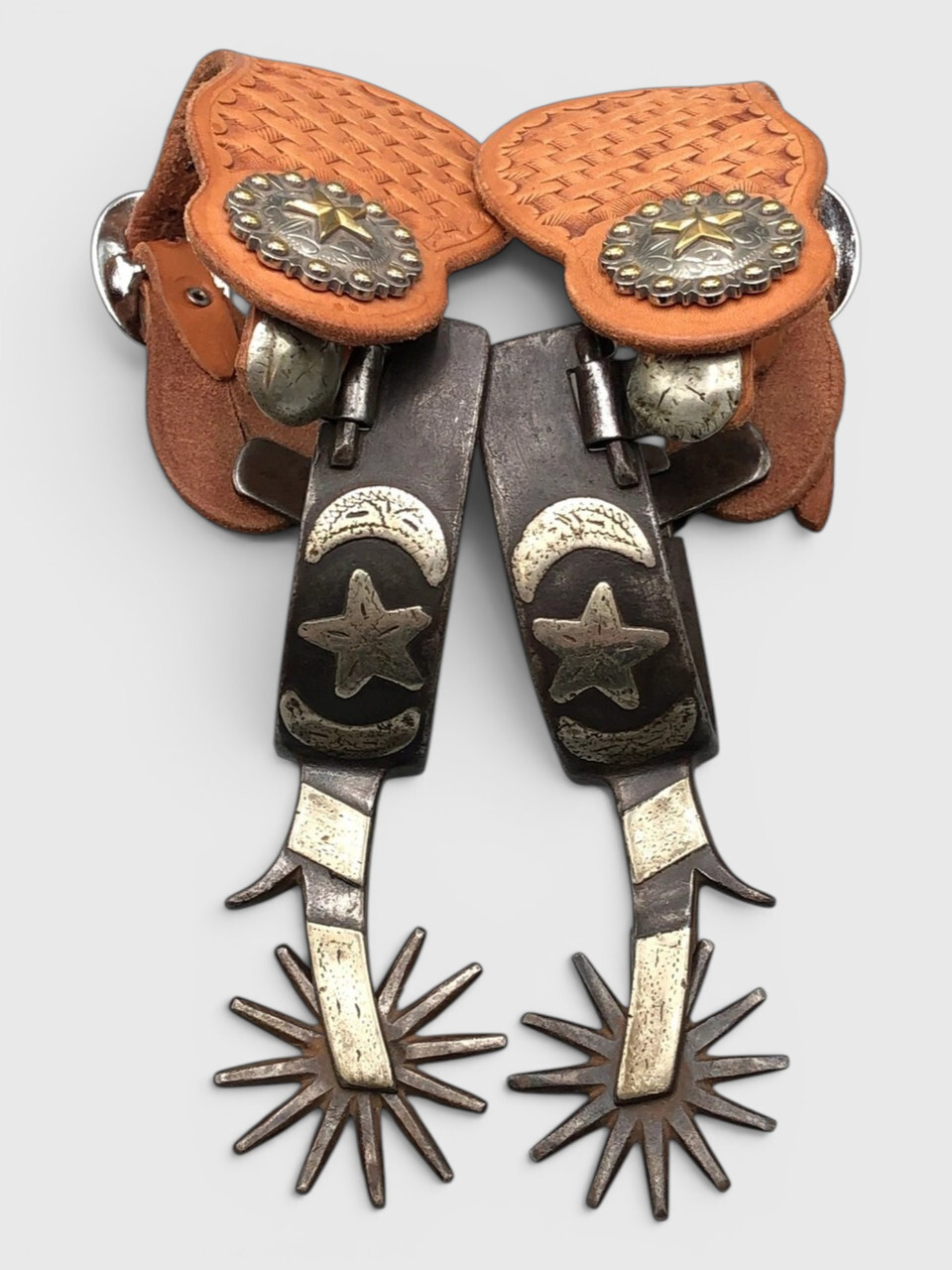
Pattern #115 — WTP.SP222
Pattern #145
We also document pattern #145, a single-mounted design dating approximately to the 1920s–1930s.
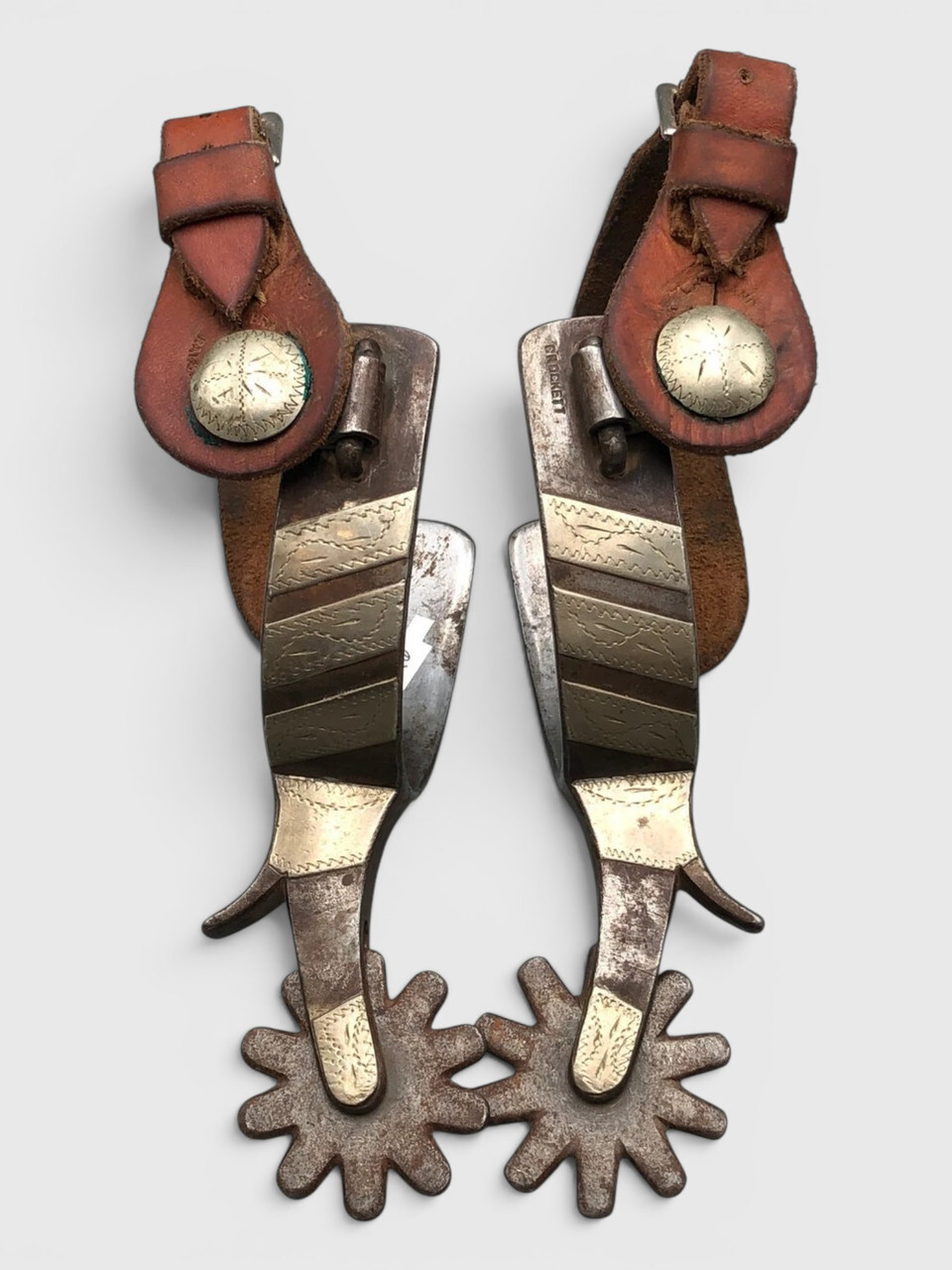
Pattern #145 — WTP.SP223
Pattern #173
A previously handled inside-marked pair uses pattern #173 with leaf-form silver overlay and engraved geometric decoration inside the heel bands.
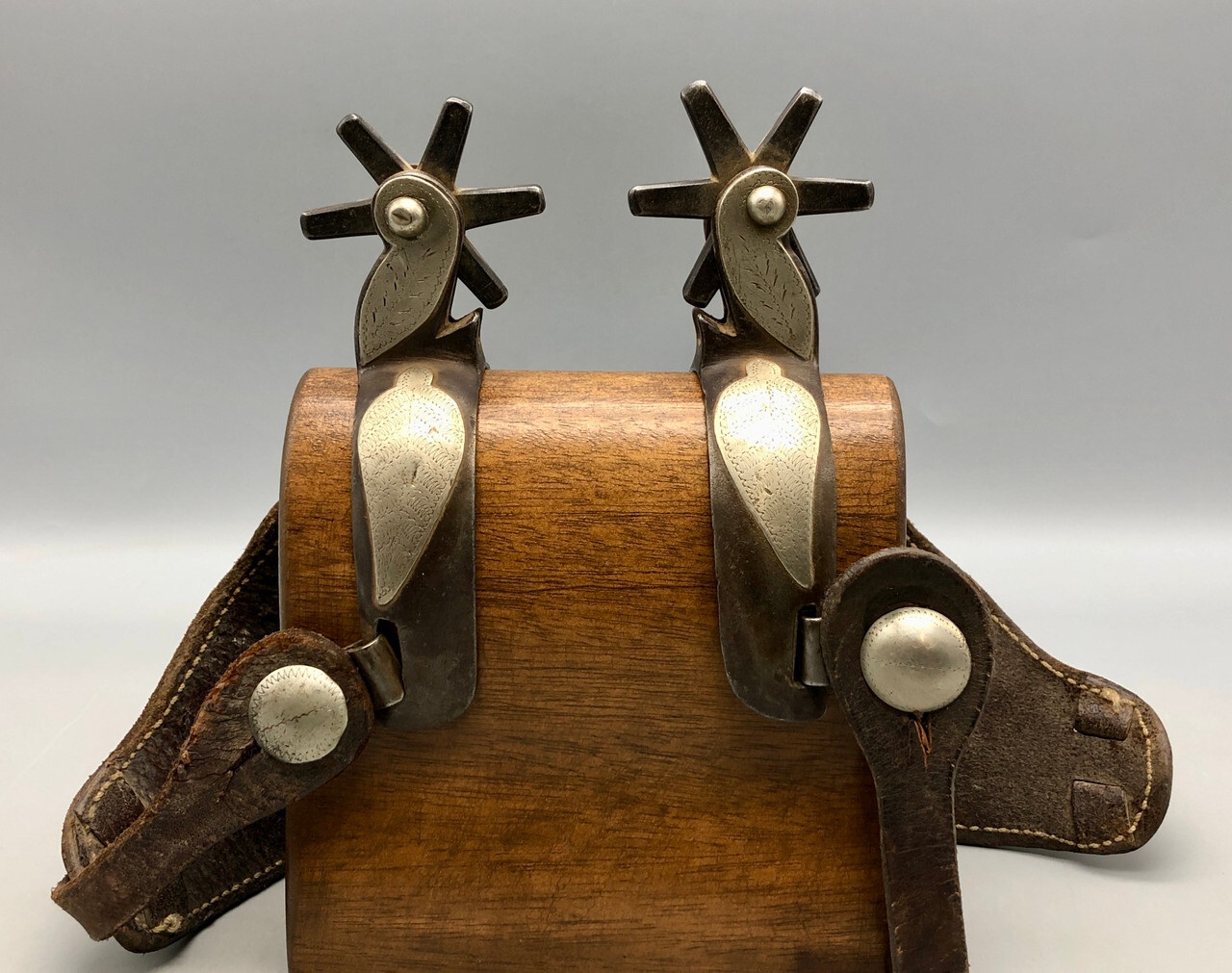
Pattern #173 — WTP.SP169
Pattern numbers should be used for comparison and identification, not treated as unique serial numbers.
What does K&C mean?
Collectors sometimes encounter spurs marked K&C, linking the names of Kelly and Crockett.
The exact business arrangement behind K&C is not completely settled. The Autry Museum documents competing explanations: one proposes a formal relationship between Pascal Kelly and Oscar Crockett, while another suggests the two operations exchanged rights to produce selected designs, with Kelly producing Crockett-style spurs and Crockett receiving access to Kelly patterns.
Christie’s has also documented K&C spurs carrying a Crockett bull-head motif.
Because the historical arrangement remains debated, this guide does not describe K&C as a definitively proven formal partnership.
K&C is evidence of a real Crockett/Kelly business relationship, but the exact structure of that relationship remains historically unresolved.
What should collectors look for?
Maker mark and placement
Record the exact wording and location of the maker mark. An inside O. CROCKETT, inside CROCKETT, under-button CROCKETT, and later company mark do not necessarily represent the same production period.
Pattern
Compare the piece with documented Crockett catalog patterns when possible. Known examples from our records include patterns #115, #145 and #173.
Construction and decoration
Heel-band shape, shank style, rowels, chap guards, silver overlay, engraving and other construction details should make sense together.
Provenance
Ownership documentation can add important context. A featured pair from our records, for example, comes with provenance linking the spurs to actor Andy Griffith.
Condition and alteration
Replacement straps, rowels, removed chap guards, later engraving and other alterations can change how a piece should be interpreted and valued.
This guide is intended as a collector reference and is not a substitute for physical examination or professional authentication.
Available from our shop
The Andy Griffith provenance spurs and pattern #145 spurs are currently available. Inventory changes, so use each product page for current price and availability.
Currently listed
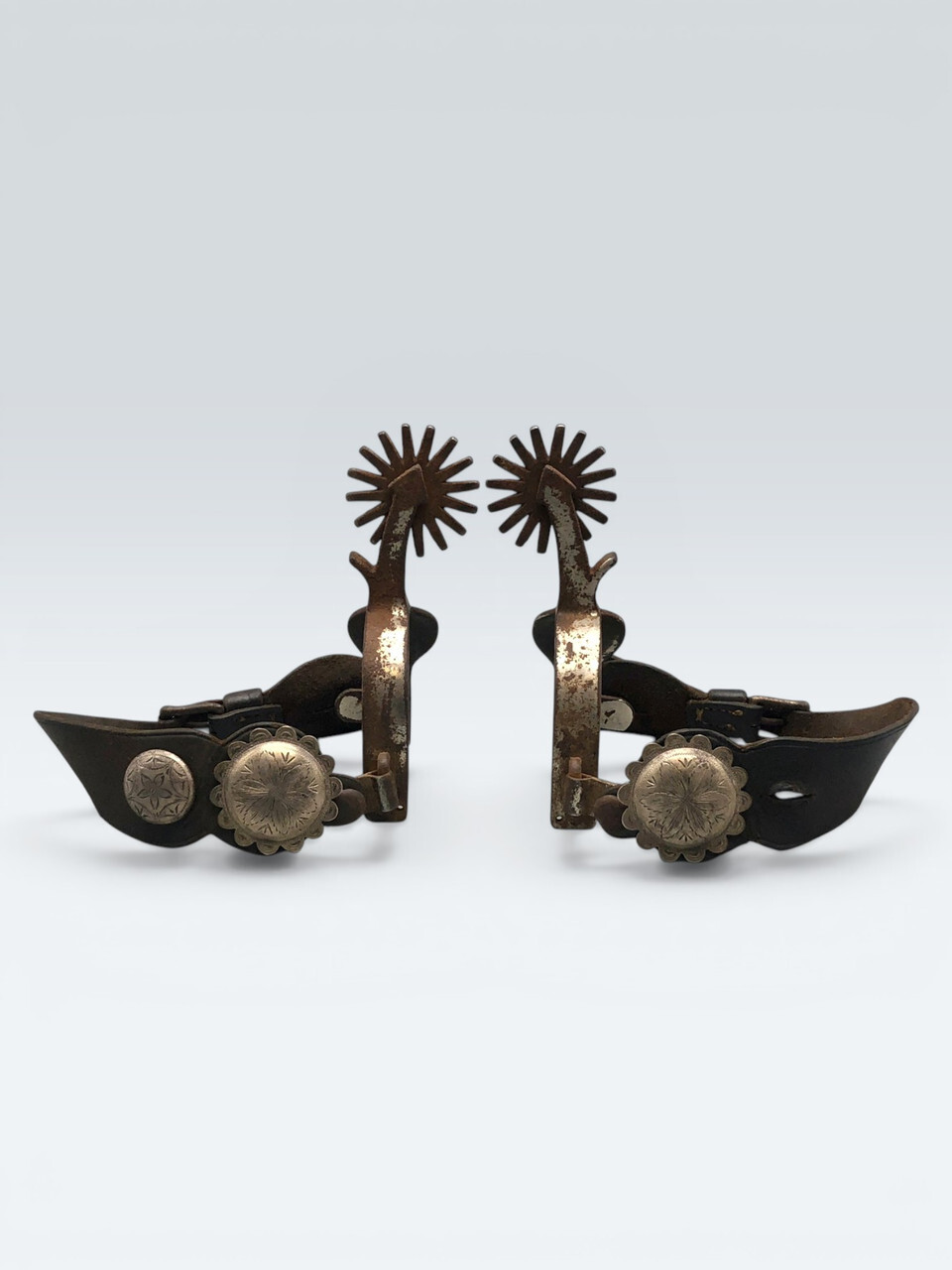
Crockett Spurs With Andy Griffith Provenance
SKU WTP.SP159
- Crockett maker
- target-pattern heel bands
- arrow-shank design
- decorated spur straps
- comes with a notebook documenting provenance to Andy Griffith
- We date the pair broadly between the 1930s and 1970s
View Current Price & Availability
Currently listed
Crockett Pattern #145 Spurs
Circa 1920s–1930s
SKU WTP.SP223
- marked CROCKETT
- Crockett Bit & Spur Co.
- pattern #145
- single mounted
- engraved silver overlay
- 10-point rowel
- leather straps
View Current Price & Availability
Previously handled by us
These historical listings are useful collector references for Crockett marks, patterns and construction. Prices shown here are our historical listing prices, not confirmed auction hammer results unless explicitly stated otherwise.
Previously handled
Inside-Marked Crockett Pattern #115 Spurs
Circa 1910–1920
SKU WTP.SP222
- marked CROCKETT
- pattern #115
- star-and-moon silver overlay
- chap guards
- 12-point rowels
- tooled straps
View Previous Listing
Previously handled
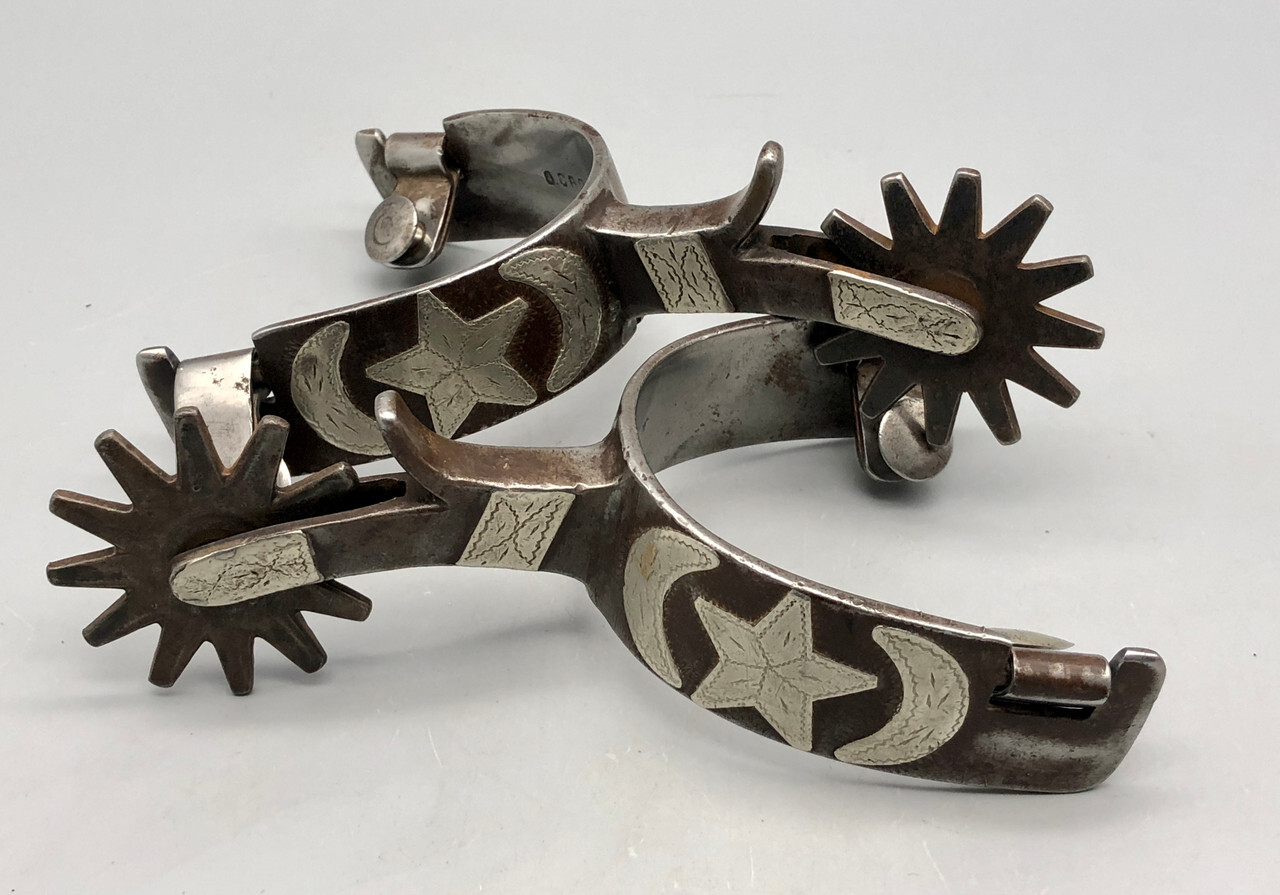
Early O. Crockett Star-and-Moon Spurs
Circa 1910–1916 (our approximate dating of this example)
Our historical listing price: $3,500
SKU WTP.SP077
- inside O. CROCKETT mark
- star and two half-moon pattern
- silver overlay
- chap guards
- large 12-point rowels
- Our approximate dating of this specific example is circa 1910–1916, not a universal date rule for every O. Crockett mark.
View Previous Listing
Previously handled
Inside-Marked Crockett Pattern #173 Leaf Spurs
Early 1900s
Our historical listing price: $1,200
SKU WTP.SP169
- CROCKETT marked inside heel bands
- pattern #173
- leaf-form silver overlay
- flowing geometric decoration incised inside the bands
- six-point Mexican-style rowels
- leather straps
View Previous Listing
Previously handled
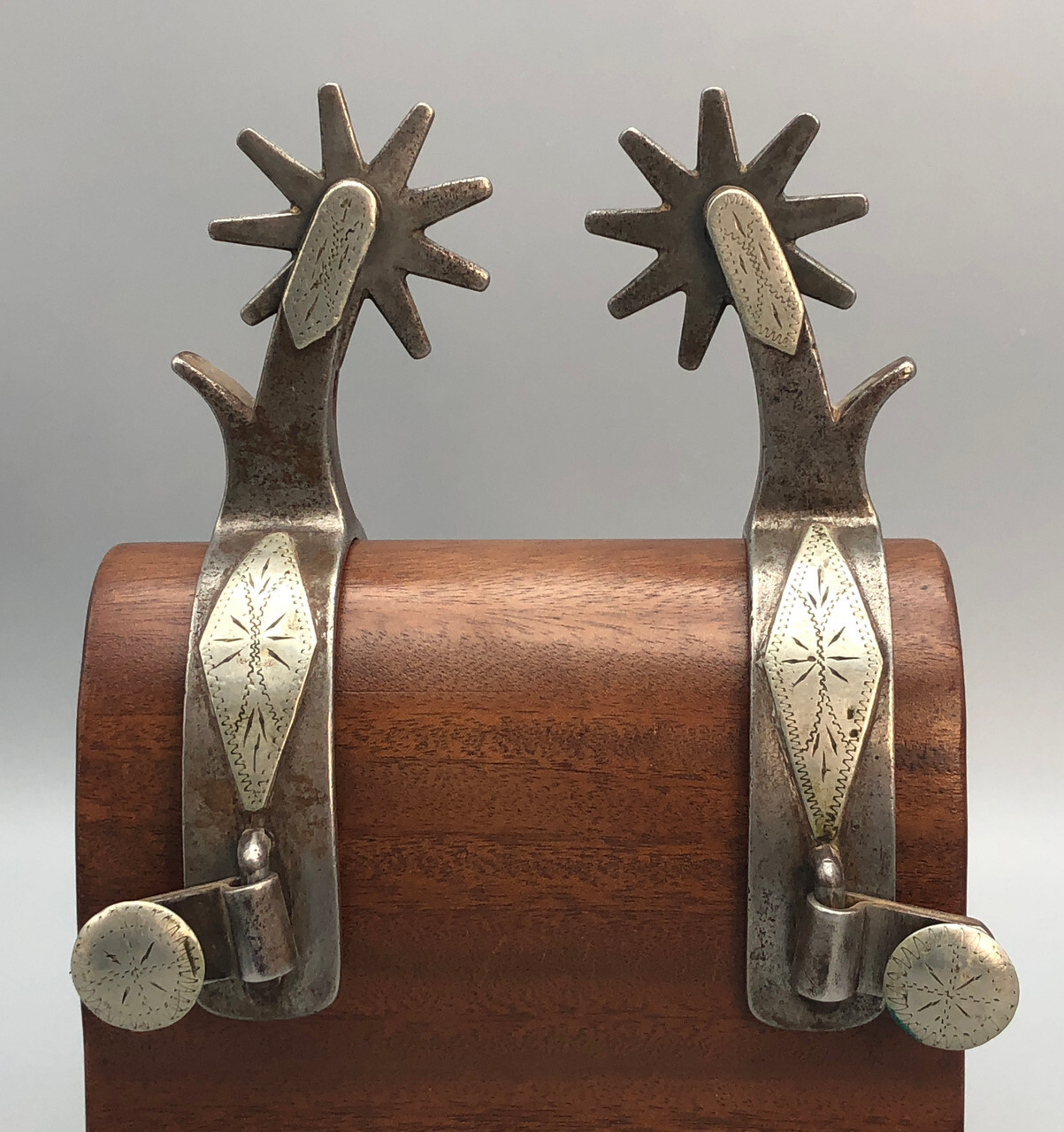
Crockett Diamond-Pattern Spurs
Circa 1920s–1930s
Our historical listing price: $600
SKU WTP.SP059
- single mounted
- engraved silver overlay
- diamond pattern
- nine-point rowels
- chap guards
- CROCKETT marked beneath the swing button
View Previous Listing
Previously handled
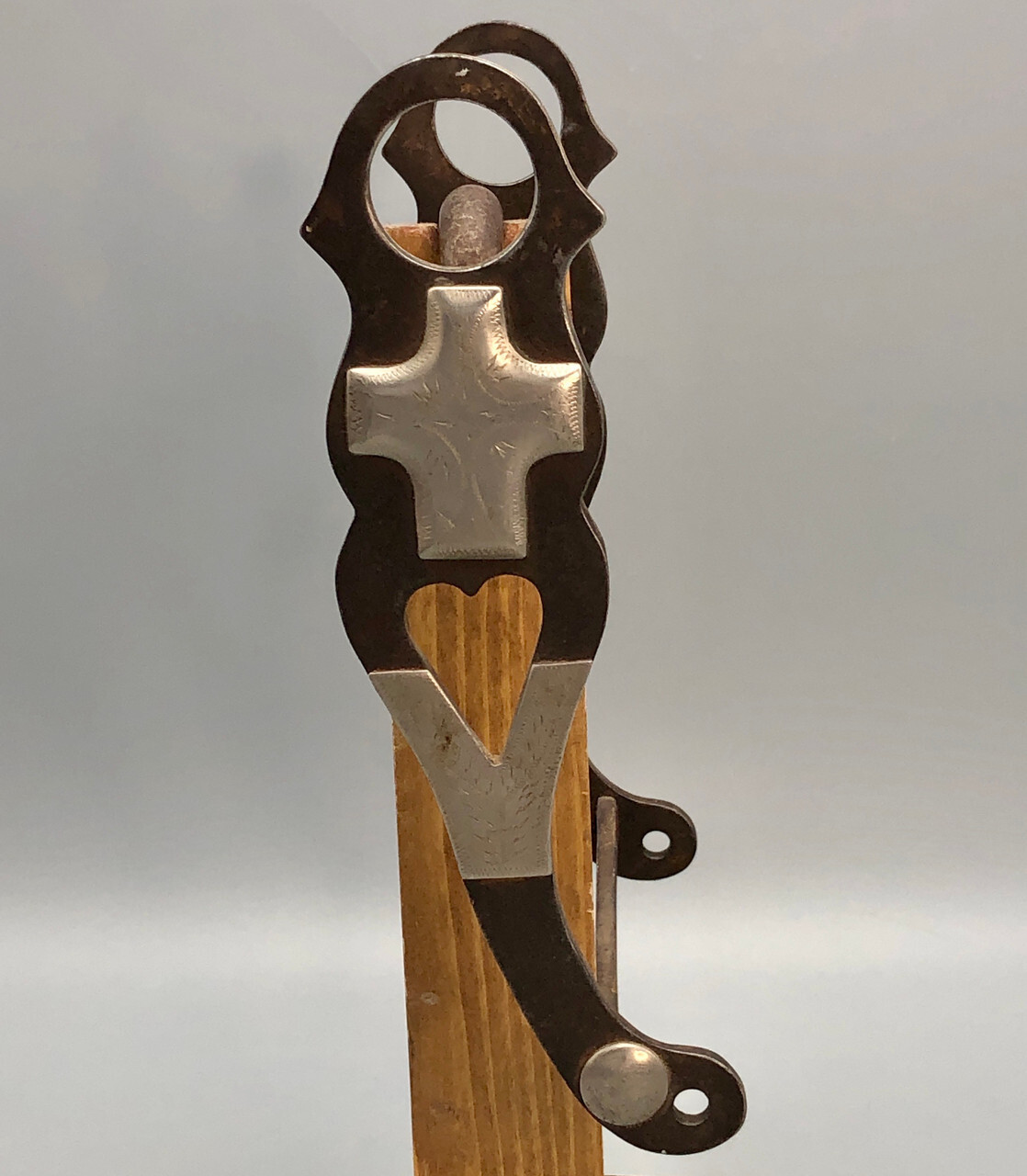
Vintage Crockett Cross-and-Heart Bit
Circa 1940s
Our historical listing price: $395
SKU WTP.BIT066
- CROCKETT hallmark inside shank
- silver cross overlays
- heart cutouts
- low-port mouthpiece
- 5-inch mouth
- 8 inches overall
View Previous Listing
When a Crockett spur becomes part of a Bohlin story
Bohlin Bit, Spur Straps and Engraved Crockett Spurs
Our historical listing price: $5,000
SKU WTP.SP201
We have also handled a vintage set combining a Bohlin-marked bit, Bohlin spur straps and spurs we identify as Crockett blanks with Bohlin-style engraving.
Our records note that Edward H. Bohlin sometimes purchased Crockett bit and spur blanks, engraved them and resold them through his own operation.
This is a useful reminder that maker history can involve more than one workshop. A collector may need to distinguish who forged the base object from who decorated, finished or retailed it.
This description follows our identification of this set. It does not establish that every Bohlin spur began as a Crockett blank, and it does not independently prove Crockett manufacture beyond that documented identification.
View Previous Listing
From Oscar Crockett to Crockett-Renalde and Kelly
-
1887
Oscar Crockett born in Pecos, Texas.
-
1916
Published maker histories place Crockett operating a blacksmith shop in Pawhuska, Oklahoma.
-
1920
Oscar Crockett and W. Brice Crockett purchase Shipley Saddlery’s bit-and-spur department and establish Crockett Bit & Spur Company in Kansas City.
-
1927
Company producing approximately 5,000 pairs of spurs; Oscar becomes sole owner.
-
1932
Crockett business moves near Lenexa, Kansas.
-
1943
Factory relocates to Boulder, Colorado.
-
1949
Oscar Crockett dies. Crockett Catalog No. 50 is also dated 1949 and is preserved by the Autry Museum.
-
1951
Hazel Crockett sells the company to James Renalde.
-
1965
The Autry dates the acquisition of Kelly to 1965, after which the combined business operated as Crockett-Renalde and Kelly. A Boulder local-history summary places the Kelly acquisition earlier, shortly after Renalde bought Crockett in 1951, so published timelines are not completely consistent.
-
1984–1985
Bit-and-spur production ends and remaining finished goods are liquidated; the Autry dates Crockett Bit & Spur Company as active through 1985.
From maker’s shop to major manufacturer
Crockett became much more than a small maker’s bench. By 1927 the company was producing approximately 5,000 pairs of spurs, and later accounts describe a work force reaching as many as 125 people after the Colorado move.
That scale is important for collectors: “Crockett” represents both Oscar Crockett the maker and Crockett Bit & Spur Company as a major Western manufacturing operation.
Where Crockett history is preserved
The Autry Museum of the American West preserves Crockett Bit & Spur Company objects and trade catalogs, including Catalog No. 50 from 1949.
The Texas Rodeo Hall of Fame in Pecos also displays a selection of original Crockett bits and spurs donated in honor of Oscar Crockett by his grandson Standley S. Skinner.
Find Crockett pieces at auction
Crockett bits and spurs continue to appear periodically in our auctions. Browse the live auction platform for current and upcoming lots.
Shop Spurs Shop Bits View Upcoming Auctions
Have Crockett bits or spurs?
If you own Crockett bits, spurs or related Western gear and are considering selling or consigning them, we can review the piece and its history.
Good photographs should include the entire object, maker marks, mark placement, rowels, shanks, heel bands, straps or mouthpiece, and any documentation or provenance that came with the piece.
Sell or Consign With Us
FAQ
Who was Oscar Crockett?
Oscar Crockett was a Texas-born bit and spur maker who founded Crockett Bit & Spur Company in 1920 after purchasing the bit-and-spur department of Shipley Saddlery in Kansas City.
Did Oscar Crockett make every spur marked CROCKETT?
No. Crockett became a substantial manufacturing company and continued operating after Oscar Crockett died in 1949. A Crockett mark establishes an important maker/company connection but does not prove Oscar personally fabricated the piece.
What is an O. CROCKETT inside mark?
Our records and other collector references treat O. CROCKETT inside the heel band as an early Crockett mark. Exact dating varies among sources and should be evaluated together with the entire object.
Are inside-marked Crockett spurs early?
Generally, inside-marked Crockett examples are associated with early production, but mark placement is not a precise date stamp. Construction, pattern and other evidence should also be considered.
What does a Crockett mark under the swing button mean?
We have documented multiple under-button Crockett examples dating approximately to 1925–1935. That placement is useful context but should not be treated as an exact universal date rule.
What are Crockett pattern numbers?
Pattern numbers identify catalog designs or models. They are not unique serial numbers assigned to individual pieces.
What does K&C mean on spurs?
K&C refers to a documented historical relationship between Kelly and Crockett, but the exact structure of that relationship remains debated. This guide does not treat the mark as proof of one definitively established formal partnership.
What happened to the Crockett company after Oscar died?
Hazel Crockett continued the company after Oscar Crockett’s death in 1949 and sold it to James Renalde in 1951. The Crockett name continued under Renalde ownership and later became part of Crockett-Renalde and Kelly. This later production belongs to company history rather than Oscar Crockett’s personal working period.
Did Edward Bohlin use Crockett pieces?
Our records state that Bohlin sometimes purchased Crockett bit and spur blanks, engraved them and resold them. We have handled a vintage set illustrating that connection.
Where can I see Crockett items in a museum?
The Autry Museum of the American West preserves Crockett objects and catalogs, while the Texas Rodeo Hall of Fame in Pecos displays a selection of original Crockett bits and spurs.
Where can I sell Crockett bits or spurs?
We buy and consign collectible Western gear. Use the Sell or Consign link on this page to contact us.