Key facts
August Buermann
1842–1928
Business
Newark, New Jersey
Buermann Manufacturing Co.
Active 1866–1926
Classic mark
Five-point star with intertwined AB
Star trademark use
Documented from 1877
Catalog scale
Roughly 440 spur designs and nearly 500 bit designs
Company transition
Sold to North & Judd in 1926
Known for
Spurs, bits, saddlery hardware, Star Brand, Hercules Bronze and Star Steel Silver
Who was August Buermann?
August Buermann was born in Germany in 1842 and settled in Newark, New Jersey, after coming to the United States and serving during the Civil War.
After the war, Buermann worked for a saddle manufacturing company in Newark. In 1866 he purchased Barclay & Company in Newark from his former employer, Alexander Barclay, and developed the operation into the August Buermann Manufacturing Company.
The business grew into a major American producer of bits, spurs and saddlery hardware. The Autry Museum records that by 1876 the company employed 35 skilled workers and sold $30,000 worth of products that year. A new four-story Newark factory equipped with modern machinery followed in 1902.
Buermann built an unusually broad catalog encompassing Western, military and other equestrian equipment. The company was capable of large-scale production while also producing higher-grade and hand-finished work.
The Museum of Northwest Colorado says Buermann turned the company over to his son in 1896. The business continued under the Buermann name until North & Judd purchased it in 1926.
August Buermann died in 1928.
A Buermann company mark identifies the manufacturing operation. It does not mean August personally manufactured every object that carries a Buermann company mark.
Hundreds of spur and bit designs
Published sources agree that Buermann produced an exceptionally large range of bits and spurs, although the exact totals differ slightly.
The Museum of Northwest Colorado describes a catalog containing about 440 spur types and nearly 500 bit designs. High Noon Western Americana gives 443 spur designs. Other collector references publish similarly close totals.
Rather than presenting one disputed number as exact, this guide uses: roughly 440 spur designs and nearly 500 bit designs.
That scale matters to collectors because a Buermann catalog match can provide meaningful evidence when identifying an old bit or pair of spurs.
The Buermann Star Brand
The five-point star became the central visual mark associated with Buermann.
A historical U.S. trademark compilation records August Buermann’s spur-and-star trademark as registered in 1882 and states that it had been used since September 1877.
Period advertising later promoted Buermann equipment as Star Brand bits and spurs.
However, collectors should not treat every five-point star as proof that a piece was manufactured during August Buermann’s original company period. The star continued to play a role after North & Judd purchased the Buermann company in 1926.
A star is an important clue — not a complete authentication by itself.
Buermann marks: What does the star mean?
Classic Buermann company mark
High Noon describes Buermann marking spurs with a five-pointed star over-stamped with B on A; the Autry Museum records that North & Judd later used a variation of Buermann’s star without the intertwined AB. We have documented this mark on a pair of antique Buermann gooseneck spurs dating approximately to the late 1800s or early 1900s. This is one of the strongest maker-mark clues for original Buermann Manufacturing Company production, but the complete object should still be evaluated.
Star + other Buermann wording
Collector references also document Buermann pieces carrying marks such as HAND FORGED STEEL, PATENT, PAT’D, HERCULES BRONZE, STAR STEEL SILVER, or other wording associated with specific Buermann product lines and manufacturing periods. Not every piece has all of these marks.
Potential later continuation mark — context required
The Autry Museum records that after North & Judd bought Buermann Manufacturing Company in 1926, North & Judd continued producing a line of Buermann spurs and used a variation of the Buermann star without the intertwined AB initials. That makes a plain or empty star especially important to evaluate in context. At the same time, some descriptions in our records use the general wording “star marked” without documenting every detail visible inside the stamp. For that reason, this guide does not date a piece solely because its description says “star.”
Do not use “star = pre-1926” or “plain star = definitely post-1926” as universal rules.
North & Judd continuation
North & Judd’s own identifying symbol was an anchor. Documented later examples can carry a Buermann-style star together with a North & Judd anchor. Rock Island Auction has documented Hercules Bronze spurs carrying both marks. A star-and-anchor combination therefore points to later North & Judd production using Buermann designs rather than August Buermann’s original pre-1926 company production.
What happened after North & Judd bought Buermann?
In 1926, longtime competitor North & Judd Manufacturing Company purchased August Buermann Manufacturing Company.
The acquisition did not make the Buermann designs disappear. The Autry Museum records that North & Judd continued producing a line of Buermann spurs and used a variation of the star symbol without the intertwined AB initials.
This creates one of the most important distinctions for collectors: Buermann design does not always equal pre-1926 Buermann manufacture.
Later North & Judd pieces can legitimately continue Buermann designs and branding traditions while belonging to a different manufacturing period.
They are not counterfeit. They are legitimate later company production.
Buermann catalog numbers
Buermann’s illustrated catalogs provide valuable reference points for identifying known designs.
Catalog numbers identify a design or model, not one unique physical object. They are not unique serial numbers.
We have documented examples associated with specific Buermann catalog numbers, including: Pattern #1417 — snake design; Pattern #1476 — chevron-style design; Pattern #2402 — “Ace” design comparison.
A strong catalog match can support an attribution, but it does not automatically prove who manufactured one unmarked surviving object.
Catalog match = identification evidence, not automatic authentication.
Exact pattern match vs. catalog attribution
Our inventory demonstrates why collectors need careful wording.
Some pieces are maker-marked and matched to a specific Buermann catalog pattern.
Other pieces are unmarked but attributed to Buermann because their shape and decoration are similar to documented catalog patterns.
Those are not the same level of evidence.
Marked + catalog match
Strongest of these comparison categories. The object carries a relevant maker mark and corresponds with a documented catalog design.
Example: WTP.SP111 — star-marked pattern #1417 snake spurs
Unmarked + strong catalog attribution
Useful attribution evidence, but not equivalent to a maker stamp.
Example: WTP.SP124 — unmarked spurs attributed to Buermann because they are similar to catalog pattern #1476
Unmarked + “similar to” a catalog design
A visual comparison only. Similarity should not be upgraded into confirmed Buermann manufacture.
Example: WTP.SP103 — maker unknown; similar to No. 2402 “Ace” pattern
Do not convert “similar to Buermann” into “made by Buermann.”
Pattern #1417: Snake design
We have documented a star-marked pair identified as Buermann catalog pattern #1417.
The spurs combine hand-engraved inlay on the snake side with deeply forged iron decoration on the opposite side. We date our example to the early 1900s.
The pair provides a strong example of how maker mark, construction and catalog comparison can work together.
This documented pair should not be read as a claim that all snake-pattern Buermann spurs are identical.
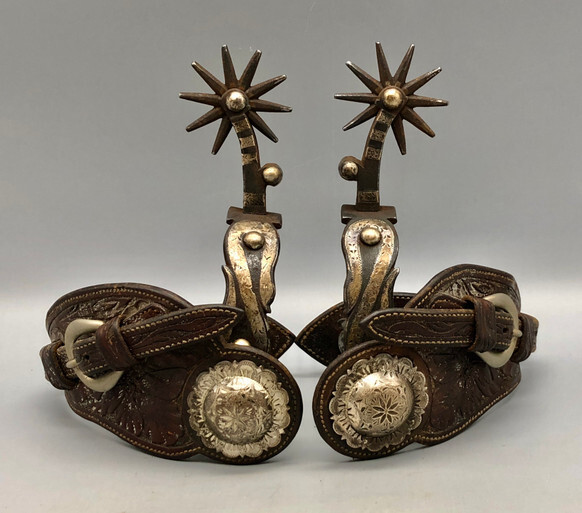
Pattern #1417 — WTP.SP111
Pattern #1476: Attribution requires care
We have handled multiple unmarked spurs that resemble Buermann catalog pattern #1476. One example is WTP.SP123, an unmarked inlaid pair attributed to Buermann.
Their chevron inlay, scalloped decoration and overall form provide meaningful comparison evidence, but we describe them as attributed to Buermann rather than maker-marked Buermann pieces.
This distinction should remain visible to collectors.
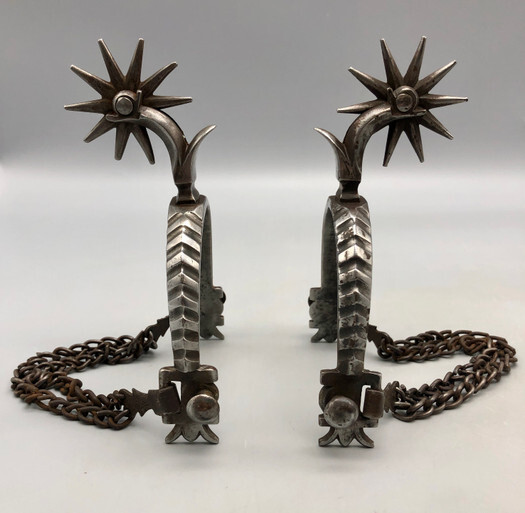
Pattern #1476 attribution — WTP.SP124
Similar to No. 2402 “Ace” does not mean Buermann-made
Another example from our records, SKU WTP.SP103, resembles Buermann’s No. 2402 “Ace” design but is unmarked and differs in construction details.
We list the maker as unknown.
It belongs on this collector hub specifically because it demonstrates a key identification rule: recognizing a Buermann design influence is not the same as authenticating Buermann manufacture.
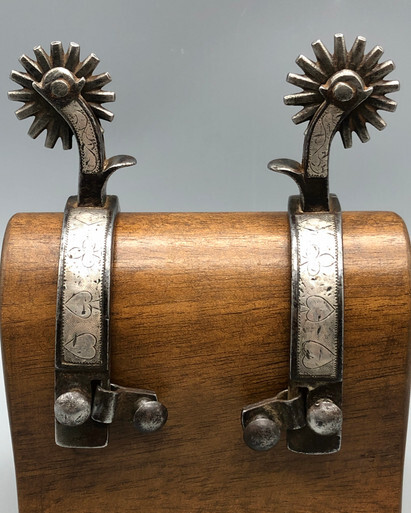
Similar to No. 2402 “Ace” — WTP.SP103, maker unknown
What is Hercules Bronze?
HERCULES BRONZE appears as a distinctive Buermann product-line marking on surviving bits and spurs.
We have handled a classic early-1900s Hercules Bronze pair with a Chief design, while other documented auction examples carry both the five-point star and HERCULES BRONZE.
Collector and auction references describe Hercules Bronze as a distinctive Buermann product line: a bronze-colored, non-rusting alloy. For identification purposes, the marked product-line name is more useful than trying to infer an exact alloy composition.
For this page, treat HERCULES BRONZE primarily as an identifiable Buermann product-line mark. A bronze-colored finish alone does not make a spur Hercules Bronze.
What is Star Steel Silver?
STAR STEEL SILVER is a documented Buermann-associated product line that continued into the North & Judd era. Period North & Judd advertising from 1940 promoted Star Steel Silver riding hardware and directed customers to request Star Steel Silver Catalog No. 41 from North & Judd Manufacturing Co.
That continuation matters to collectors: a STAR STEEL SILVER mark should not, by itself, be treated as proof of pre-1926 Buermann manufacture. The complete mark, company-era clues, construction and catalog evidence should be considered together.
Star Steel Silver should not be interpreted as meaning an object is sterling silver.
Patents and product innovation
Buermann’s manufacturing operation was also active in product development and patenting.
August Buermann received U.S. Patent No. 218,705 in 1879 for an improvement to spurs involving an elastic covering over the heel band.
A 1906 bridle-bit patent by Harry Turton was assigned to August Buermann.
In 1916, George and Henry Buermann received another spur patent assigned to August Buermann Manufacturing Company.
These records help illustrate that Buermann was not simply reproducing one traditional design: the company was actively developing and manufacturing equestrian hardware over several decades.
Later patents assigned to August Buermann or the manufacturing company do not mean August personally invented every later company patent.
What should collectors look for?
Maker mark
Photograph and record the complete mark, including whether the star contains intertwined AB initials, whether an anchor appears nearby and whether additional wording such as HAND FORGED, HERCULES BRONZE or STAR STEEL SILVER is present.
Catalog pattern
Compare the object with documented Buermann catalogs when possible, but distinguish an exact match from a merely similar design.
Company era
A pre-1926 Buermann company piece and a later North & Judd continuation piece can both be legitimate but belong to different periods.
Construction
Examine heel-band shape, shank, rowels, chap guards, chains, decoration, inlay and whether those elements correspond with documented examples.
Marked vs. attributed
A maker-marked object carries different evidence from an unmarked item attributed through catalog comparison.
Provenance and condition
Original straps, chains, documented ownership, repairs, missing components and later modifications can materially affect interpretation and value.
This guide is intended as a collector reference and is not a substitute for physical examination or professional authentication.
Available from our shop
These product pages provide useful examples of how Buermann identification and attribution work in practice. Inventory changes, so use each product page for current price and availability.
Currently listed Attributed
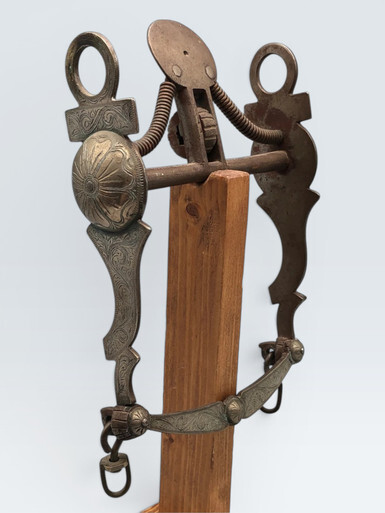
Antique Spade Bit Attributed to Buermann
SKU WTP.BIT169
- unmarked
- Our attribution: likely Buermann
- catalog-style comparison
- silver inlay
- spade mouth
- copper roller
- copper-wrapped braces
We describe the attribution as an informed opinion, not a confirmed maker mark.
View Current Price & Availability
Currently listed Attributed
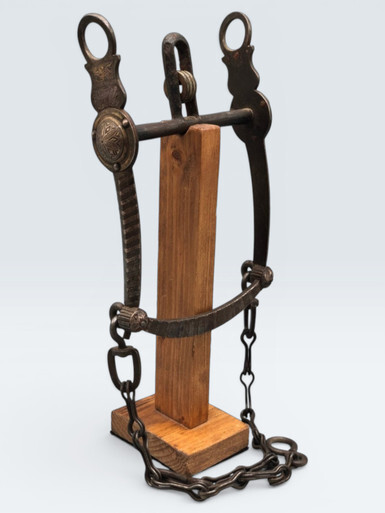
Antique Half-Breed Bit Attributed to Buermann
SKU WTP.BIT170
- unmarked
- Our attribution: likely old Buermann
- silver inlay
- half-breed mouthpiece with cricket
- rein chains
We describe the attribution as an informed opinion, not a confirmed maker mark.
View Current Price & Availability
Previously handled by us
These documented examples preserve useful references for Buermann marks, catalog patterns and attribution levels. Prices shown are our historical listing prices, not confirmed auction hammer results unless explicitly stated otherwise.
Previously handled
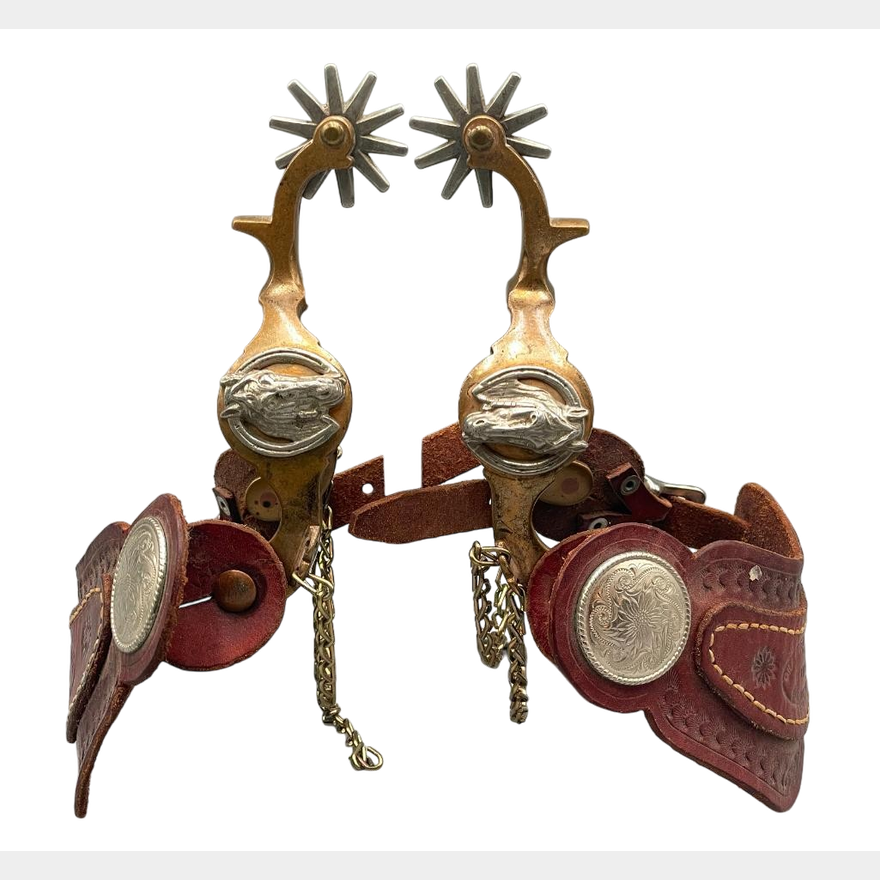
Antique Pair Star-Marked Horsehead-Theme Hercules Bronze Spurs by Buermann
WTP Item 332
September 9, 2026
Confirmed auction result: Sold for $250 (hammer)
Estimate: $250–$500
Antique — our description
- marked with a star
- HERCULES BRONZE product-line wording
- cast horsehead-and-horseshoe medallion motif
- 10-point star rowels
- chap guards and heel chains
- stamped leather spur straps with conchos
- provenance: estate of Gordon “Rex” Sayers
We catalog this auction lot as Buermann.
View Auction Result
Previously handled
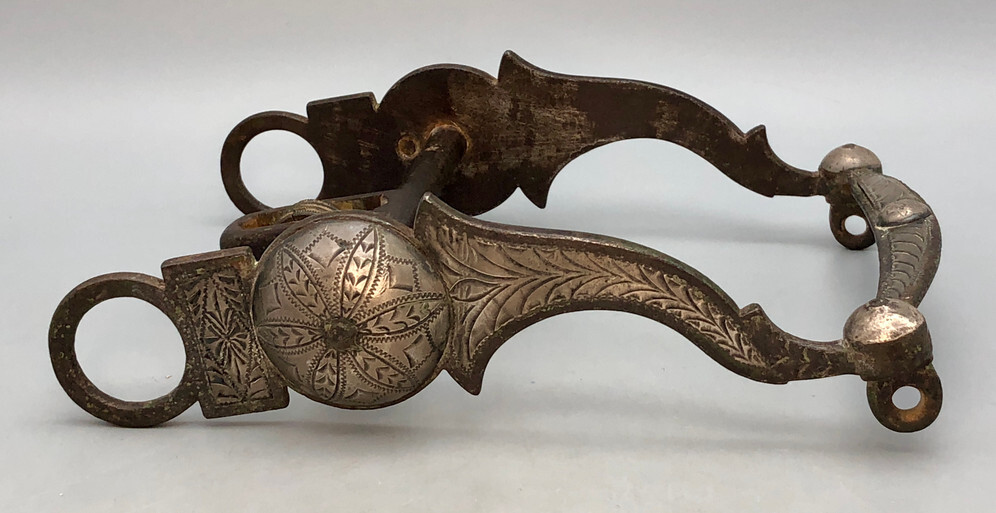
Arizona-Style Buermann Hand-Forged Bit — Circa 1900
Circa 1900 — our dating
SKU WTP.BIT069
- Buermann
- early Buermann star hallmark on the mouthpiece
- HAND FORGED STEEL wording
- silver inlay
- hand-engraved conchos
- Arizona-style bit
- We date the example to circa 1900
View Previous Listing
Previously handled
Chevron Pattern Spurs Attributed to Buermann
Early 1900s — our dating
SKU WTP.SP124
- unmarked
- attributed to August Buermann
- similar to catalog pattern #1476
- catalog comparison referenced to page 2
- chevron-style inlay
- scalloped off-side pattern
- turned-up chap guards
- 10-point rowels
View Previous Listing
Previously handled
Star-Marked Buermann Snake Spurs — Pattern #1417
Early 1900s — our dating
Our historical listing price: $3,250
SKU WTP.SP111
- marked with Buermann star hallmark
- catalog pattern #1417
- snake design
- hand-engraved inlays
- forged off-side decoration
- 10-point handmade rowels
- double heel chains
View Previous Listing
Previously handled
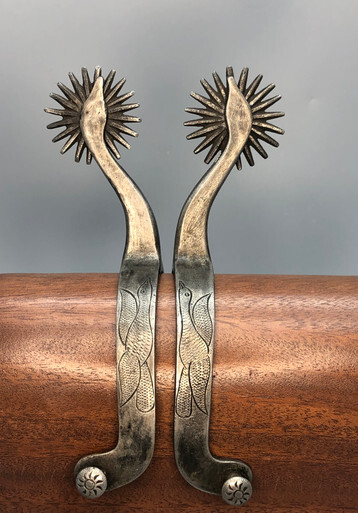
Early AB-in-Star Buermann Gooseneck Spurs
Late 1800s or early 1900s — our dating
Our historical listing price: $600
SKU WTP.SP087
- AB inside star
- gooseneck design
- gooseneck shank
- engraved/chased heel-band decoration
- 20-point rowels
This is the clearest example in our records of the classic AB-in-star mark.
View Previous Listing
Previously handled
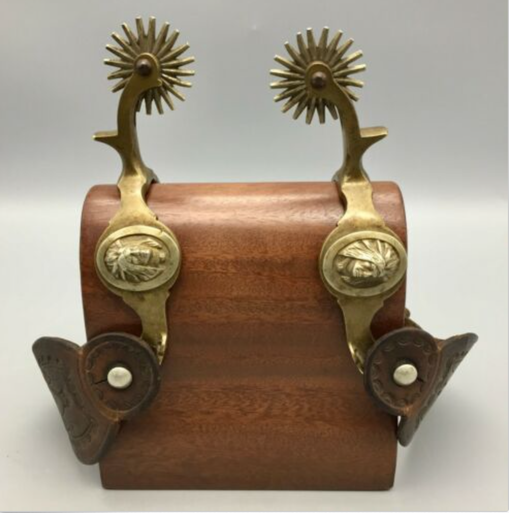
Buermann Hercules Bronze Chief Spurs
Early 1900s — our dating
Our historical listing price: $350
SKU WTP.SP40
- Hercules Bronze product line
- single mounted
- Chief design
- leather straps
View Previous Listing
Previously handled
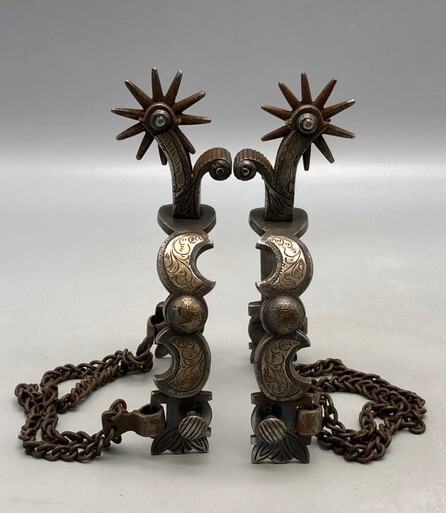
Buermann Crescent Silver-Inlay Spurs
Our historical listing price: $1,250
SKU WTP.SP143
- Buermann
- HAND FORGED wording
- crescent pattern
- silver inlay
- chased-steel decoration
- original heel chains
- turned-up chap guards
View Previous Listing
Previously handled
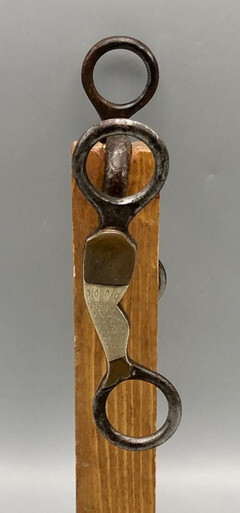
Star-Marked Buermann Gal-Leg Bit
Antique / pre-1930s — our description
Our historical listing price: $600
SKU WTP.BIT140
- marked with star
- gal/lady-leg theme
- brass and silver appliqué
- 4¾-inch mouth
- approximately 5¾ inches overall
This star mark alone is not used here to assign a pre-1926 company date.
View Previous Listing
Similar to Buermann is not the same as Buermann
Maker unknown — comparison only
Card-Suit Spurs Similar to Buermann No. 2402 “Ace”
Our historical listing price: $950
SKU WTP.SP103
Our records note that these spurs look similar to Buermann catalog No. 2402 “Ace,” but they are unmarked and differ in construction details. We list the maker as unknown. They are included here to demonstrate why design similarity must not be converted into a confirmed maker attribution.
View Comparison Example
What have documented Buermann spurs brought at auction?
Auction results vary widely depending on mark, pattern, rarity, originality, condition and provenance. These results are examples, not a universal Buermann price guide.
| Example |
Auction |
Result |
Notes |
| Spectacular Buermann Snake Spurs (lot 221) |
New Frontier Western Auctions — August 27, 2022 |
Reported: $5,700 |
Very early single-inlaid Buermann spurs with cut-out snake heel bands, deeply chased iron offsides and an early AB star mark. These are a separate auction example, not WTP’s exact #1417 pair. |
| Buermann Crescent Moon Pattern No. 1401 Spurs |
High Noon Western Americana — January 28, 2012 |
Sold to floor: $2,750 |
Estimate $2,000–$3,000. Catalog pattern No. 1401; star mark; FORGED STEEL maker wording. |
| Buermann Union Shield Spurs |
High Noon Western Americana — January 28, 2012 |
Sold to floor: $1,600 |
Estimate $1,500–$2,000. Star / AB maker mark; hand-forged steel; silver-inlaid shield pattern. |
A star alone does not determine value
Buermann equipment ranges from relatively common production models to scarce hand-finished patterns and highly decorative examples.
Collectors may consider: maker mark; pre-1926 vs. North & Judd era; exact catalog pattern; marked vs. attributed status; original chains and straps; hand-forged vs. mass-produced construction; decorative work; rarity; provenance; condition.
Two objects carrying a Buermann-associated star can therefore differ greatly in historical significance and market value.
The Roosevelt spurs
The Museum of Northwest Colorado preserves an elaborate pair of Buermann spurs it identifies as the Roosevelt design, dating approximately to 1880.
The museum describes the Roosevelt line as among Buermann’s top specialty work and notes that the company maintained higher-grade handcrafted lines alongside its large-scale production.
The museum’s pair demonstrates why Buermann should not be understood only as a mass-production company.
August Buermann & Company timeline
-
1842
August Buermann born in Germany.
-
1860s
Buermann comes to the United States and later serves during the Civil War.
-
1865
After the war, Buermann works in saddlery manufacturing in Newark.
-
1866
Buermann purchases Barclay & Company and develops the operation that becomes August Buermann Manufacturing Company.
-
1876
The Autry records 35 skilled workers and $30,000 in annual product sales.
-
1877
Historical trademark records document use of Buermann’s spur-and-star mark beginning in September.
-
1879
August Buermann receives U.S. Patent No. 218,705 for an improvement in spurs.
-
1882
Historical trademark records list registration of Buermann’s spur-and-star mark.
-
1896
The Museum of Northwest Colorado says Buermann turned the company over to his son.
-
1902
Buermann Manufacturing moves into a new four-story Newark factory.
-
1907
Buermann No. 33 illustrated Star Brand catalog is documented.
-
1914
Buermann No. 34 illustrated Star Brand catalog is documented.
-
1916
George and Henry Buermann receive a spur patent assigned to August Buermann Manufacturing Company.
-
1926
North & Judd purchases August Buermann Manufacturing Company and continues producing selected Buermann lines/designs.
-
1928
August Buermann dies.
Find Buermann pieces with us
We periodically handle Buermann bits and spurs through both our shop and auction platform. Some are maker-marked; others are explicitly presented as informed attributions.
Inventory changes, so use our live listings for current price and availability.
Shop Spurs Shop Bits View Upcoming Auctions
Have a Buermann bit or pair of spurs?
If you own a Buermann bit, pair of spurs or related Western gear and are considering selling or consigning it, we can review the piece and its history.
Before contacting us, photograph:
- the entire object
- both sides
- every maker mark
- the inside of heel bands
- bottoms of shanks
- any star or anchor
- AB initials if present
- catalog or pattern number
- Hercules Bronze / Star Steel Silver / Hand Forged wording
- straps, chains and rowels
- any documentation or provenance
Sell or Consign With Us
FAQ
Who was August Buermann?
August Buermann was a German-born Newark manufacturer whose company became a major American producer of bits, spurs and saddlery hardware. Buermann Manufacturing Company operated from 1866 until its sale to North & Judd in 1926.
What is the classic August Buermann maker mark?
The classic Buermann company mark is a five-point star containing intertwined AB initials.
Does every star mark mean August Buermann?
No. The star existed in multiple contexts, and North & Judd continued a variation of the Buermann star after buying the company in 1926. The complete mark and object must be evaluated.
What does an anchor with a Buermann-style star mean?
An anchor is associated with North & Judd. Documented later pieces can combine an anchor with the Buermann star, indicating North & Judd-era production using Buermann designs.
What happened to Buermann after 1926?
North & Judd purchased August Buermann Manufacturing Company and continued producing selected Buermann designs and lines. Later pieces can therefore be legitimate Buermann-pattern production without belonging to the original pre-1926 company period.
What do Buermann catalog numbers mean?
They identify catalog designs or models, not unique serial numbers assigned to one individual piece.
Is a catalog match enough to prove a spur is Buermann?
No. A close catalog match can support attribution, but an unmarked piece should not automatically be upgraded to confirmed Buermann manufacture.
What is Hercules Bronze?
Hercules Bronze is a documented Buermann-associated product-line marking found on bits and spurs. Collector and auction references describe it as a bronze-colored, non-rusting alloy, but this guide does not rely on a precise alloy composition to identify or date a piece.
What is Star Steel Silver?
Star Steel Silver is a documented Buermann-associated product line that continued into the North & Judd era. Period North & Judd advertising promoted Star Steel Silver riding hardware, so the mark should not by itself be treated as proof of pre-1926 Buermann manufacture. It also should not be interpreted as meaning an object is sterling silver.
What is an AB-in-star mark?
The intertwined AB inside a five-point star is the classic Buermann mark identified by museum and collector references.
Did Buermann mass-produce spurs?
Buermann became an important large-scale manufacturer, but museum records also document higher-grade handcrafted specialty lines. The company produced equipment across a wide range of quality and styles.
How many spur and bit designs did Buermann make?
Published totals vary slightly. The Museum of Northwest Colorado describes about 440 spur types and nearly 500 bit designs, while other references publish very similar counts.
Where can I see museum-quality Buermann spurs?
The Museum of Northwest Colorado preserves important Buermann material, including a highly decorated pair it identifies as Roosevelt spurs.
Where can I sell Buermann bits or spurs?
We handle collectible Western gear through our shop and auctions. Use the Sell or Consign link on this page to contact us.
Sources & further reading
Our Records
- Arizona-Style Buermann Hand-Forged Bit — WTP.BIT069
- Antique August Buermann Star-Marked Snake Pattern Spurs — WTP.SP111
- Antique Buermann Gooseneck Spurs — WTP.SP087
- Hercules Bronze Chief Design Spurs — WTP.SP40
- Chevron Pattern Spurs Attributed to Buermann — WTP.SP124
- Antique Inlay Spurs Attributed to Buermann — WTP.SP123 (unmarked; attributed to Buermann; similar to catalog pattern #1476)
- Buermann Crescent Silver-Inlay Spurs — WTP.SP143
- Rare Buermann Antique Gal-Leg Bit — WTP.BIT140
- Antique Spade Bit — Likely Buermann — WTP.BIT169
- Antique Half-Breed Bit — Likely Buermann — WTP.BIT170
- WTP Auction Record — Item 332, Antique Pair Star-Marked Horsehead Theme Hercules Bronze Spurs by Buermann — September 9, 2026
- Vintage Card-Suit Spurs Similar to Buermann No. 2402 — WTP.SP103
Museum / institutional / primary
- The Autry Museum of the American West — Buermann Manufacturing Company (company 1866–1926; 1876 employment/sales; 1902 factory; 1926 North & Judd; later star without AB)
- Museum of Northwest Colorado — August Buermann Spurs (1842 birth; catalog scale; Roosevelt; 1896 handover; 1926 sale)
- Historical U.S. trademark compilation (digitized historical trademark publication; spur-and-star; 1882 registration; use from September 1877)
- Google Patents — U.S. Patent No. 218,705 (1879 spur patent)
- Google Patents — U.S. Patent No. 823,565 — Harry Turton bridle-bit patent, assigned to August Buermann, 1906
- Google Patents — U.S. Patent No. 1,182,344 (George and Henry Buermann; assigned to company; 1916)
- Open Library — August Buermann Manufacturing Co. catalogs (No. 33 1907; No. 34 1914; Star Brand titles)
- North & Judd Manufacturing Co. — 1940 Star Steel Silver Riding Hardware Advertisement (digitized period publication promoting Star Steel Silver riding hardware and Star Steel Silver Catalog No. 41)
Collector / market
- High Noon — August Buermann Maker Reference (marks; Star Steel Silver; Hercules Bronze; approximate design counts)
- High Noon Western Americana Auction — January 28, 2012 (Crescent Moon No. 1401 $2,750; Union Shield $1,600)
- Journal of Antiques & Collectibles, October 2022 — New Frontier Western Show & Auction, August 27, 2022 (Buermann inlaid spurs with cut-out snake heel bands, $5,700)
- New Frontier Western Auctions — Lot 221, “Spectacular Buerman Snake Spurs” (iCollector)
- oldspurs.com — August Buermann
- Rock Island Auction — North & Judd / Buermann Pattern Spurs (star + anchor; North & Judd continuation; Hercules Bronze later production context)